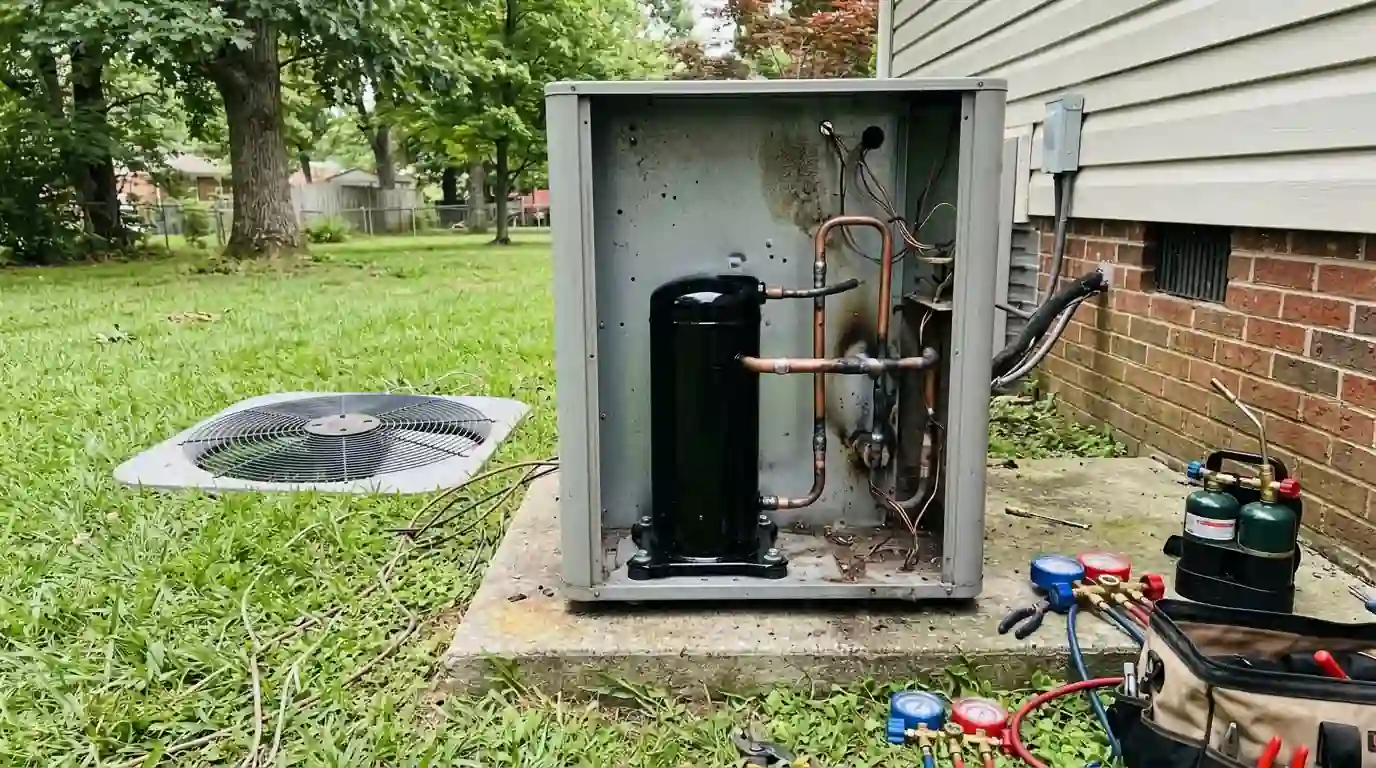
AC compressor replacement in Nashville should only follow a test showing the compressor itself has failed. A technician checks the windings with an ohmmeter, the capacitor, the contactor and the amp draw at startup. A weak start may only need a hard-start kit. A grounded or seized compressor needs replacing, priced next to a new system. Call (615) 412-2815 at any hour.
How we tell a dead compressor from a failed start part
The compressor is the pump that moves refrigerant, and it is the most expensive part of the outdoor unit. When it stops starting, the cause is often outside it: a failed run capacitor, a burned contactor or a loose wire. We rule those out before condemning the compressor.
If the compressor has a shorted or grounded winding or a seized mechanism, replacement means recovering the refrigerant, cutting out the old one, brazing in the new one with a new filter drier and evacuating to a deep vacuum. On an older unit that cost sits close to a new matched system, so we price both.
Compressor that will not start
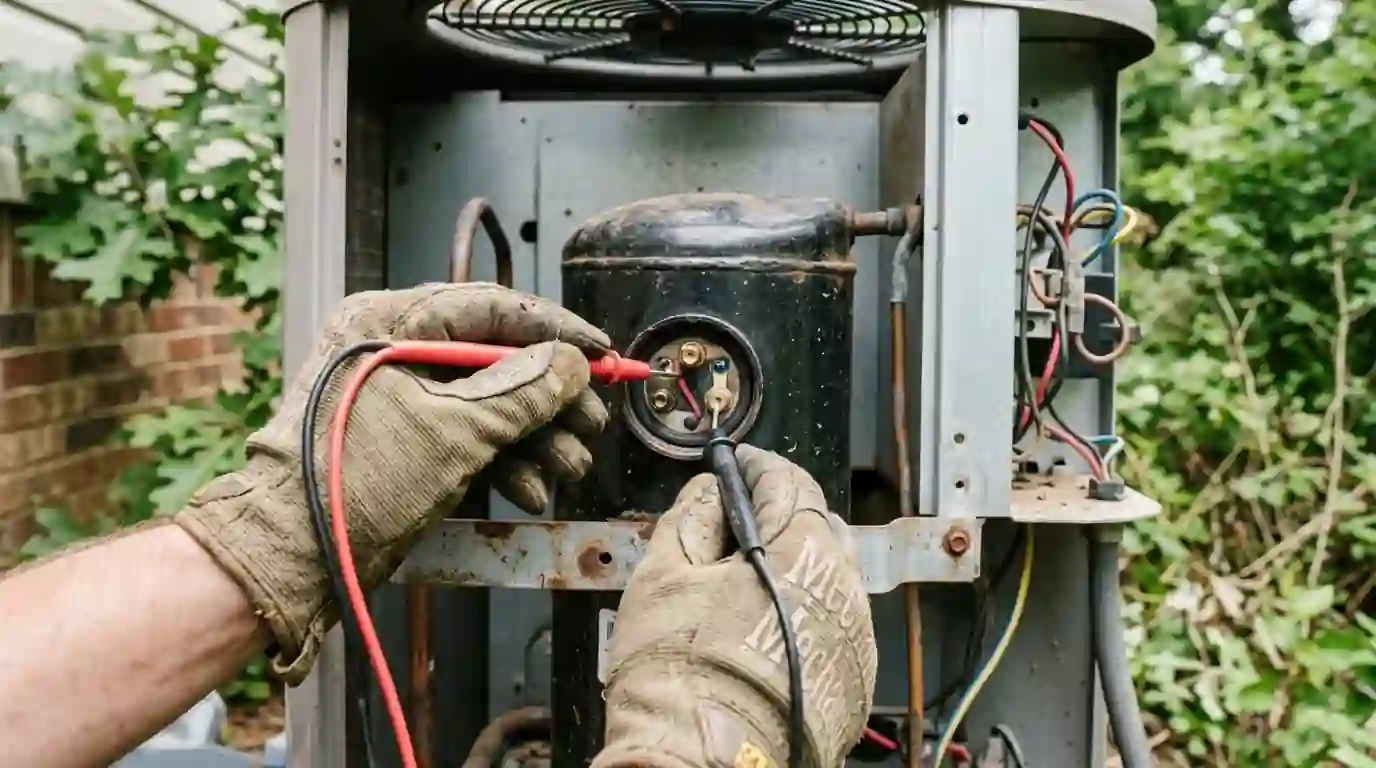
A compressor that will not start may hum and then click off on its internal overload, trip the breaker at once, or stay silent while the outdoor fan runs. Each points somewhere different. A hum with high amp draw often means a weak capacitor or a stuck mechanism. An instant trip can mean a winding shorted to ground.
We read the resistance across the three terminals and from each one to ground, measure the capacitor and watch the amp draw at startup. If the compressor shell is hot, we let it cool first, since an open overload can make a good compressor test as bad.
Hard-start kit or replacement
A hard-start kit adds a start capacitor and a relay that give the compressor a stronger push for the first second. On a compressor with healthy windings that struggles to start against pressure, it can restore reliable starts for a small fraction of the cost of replacement.
It won't fix a grounded winding, a seized compressor or one that has lost its valves. Those need a new compressor or a new system, and the age of the coil, fan motor and cabinet decides which.
Hard-start kit, new compressor or new system?
| What we find | Hard-start kit | New compressor | New system |
|---|---|---|---|
| Windings | Healthy, slow to start | Shorted, open or grounded | Any failure on an older unit |
| System age | Any age | Fairly young system | Older system or R-22 |
| Rest of the system | Runs well | Coil and fan motor sound | Coil, fan or cabinet also worn |
| Relative cost | Lowest | High | Highest, with all new parts |
Why compressor replacement costs vary so much
HomeGuide lists compressor replacement at $1,800 to $2,800 when the owner pays for the part, and $600 to $1,200 when the manufacturer still covers the compressor; that is a national market range, not our quote.
- Manufacturer coverage. A compressor still covered by its maker leaves mostly labor and refrigerant to pay.
- Compressor type. Two-stage and variable-speed compressors cost more than single-stage ones.
- Refrigerant. The full charge is replaced, and R-22 costs far more per pound than R-410A.
- Burnout cleanup. A burned-out compressor leaves acid in the system that calls for extra filter driers and an acid test.
- Night and weekend calls. Diagnosis outside regular hours can carry a higher service rate.
What a Nashville heat wave does to a tired compressor
Nashville hit its all-time record of 109 degrees on June 29, 2012, inside a run of near or above 100-degree days from June 28 to July 8. In heat like that, outdoor pressures climb and the compressor starts against a heavier load every cycle. One with a weak capacitor or worn windings that limped through May often fails in that first long stretch. So on every summer no-cooling call, we check the start parts before we condemn the compressor.
How we confirm and replace a failed compressor
- 1
Test the start parts
The capacitor, contactor and wiring are checked before the compressor itself.
- 2
Test the compressor
Winding resistance, ground faults and startup amps show whether it can be saved.
- 3
Price both paths
You see the compressor repair and a matched new system side by side.
- 4
Replace and clean up
The new compressor is brazed in with a new filter drier, then the system is evacuated, charged and tested.
Signs the compressor is in trouble
The compressor tries to start and its overload shuts it off.
A breaker that trips as the outdoor unit starts can mean a shorted winding.
The outdoor fan spins but the compressor is not pumping.
A hard knock or rattle can mean worn internal parts.
A very hot, quiet compressor shell means its overload has opened.
A struggling compressor draws more current for less cooling.
Brands we work on
We service and install equipment from the major manufacturers, including Carrier, Trane, Lennox, Rheem, Goodman, American Standard, Daikin, Mitsubishi Electric, Bryant, Ruud, York and Amana.
Compressor questions from Nashville homeowners
Usually a failed capacitor, a stuck compressor or a contactor problem. A hard-start kit or a new capacitor fixes many of these without a new compressor.
On a system near the end of its life, usually not. The cost is close to a new matched system, and the coil and fan motor are just as old.
No. It only helps the compressor start. It cannot save one with a shorted or grounded winding.
Common causes are a failed capacitor, low refrigerant from a leak, a dirty outdoor coil and liquid refrigerant reaching the compressor. We look for the cause so the new one does not fail the same way.
No. Repeated resets on a compressor drawing high current can damage it and the wiring. Leave the breaker off and call.