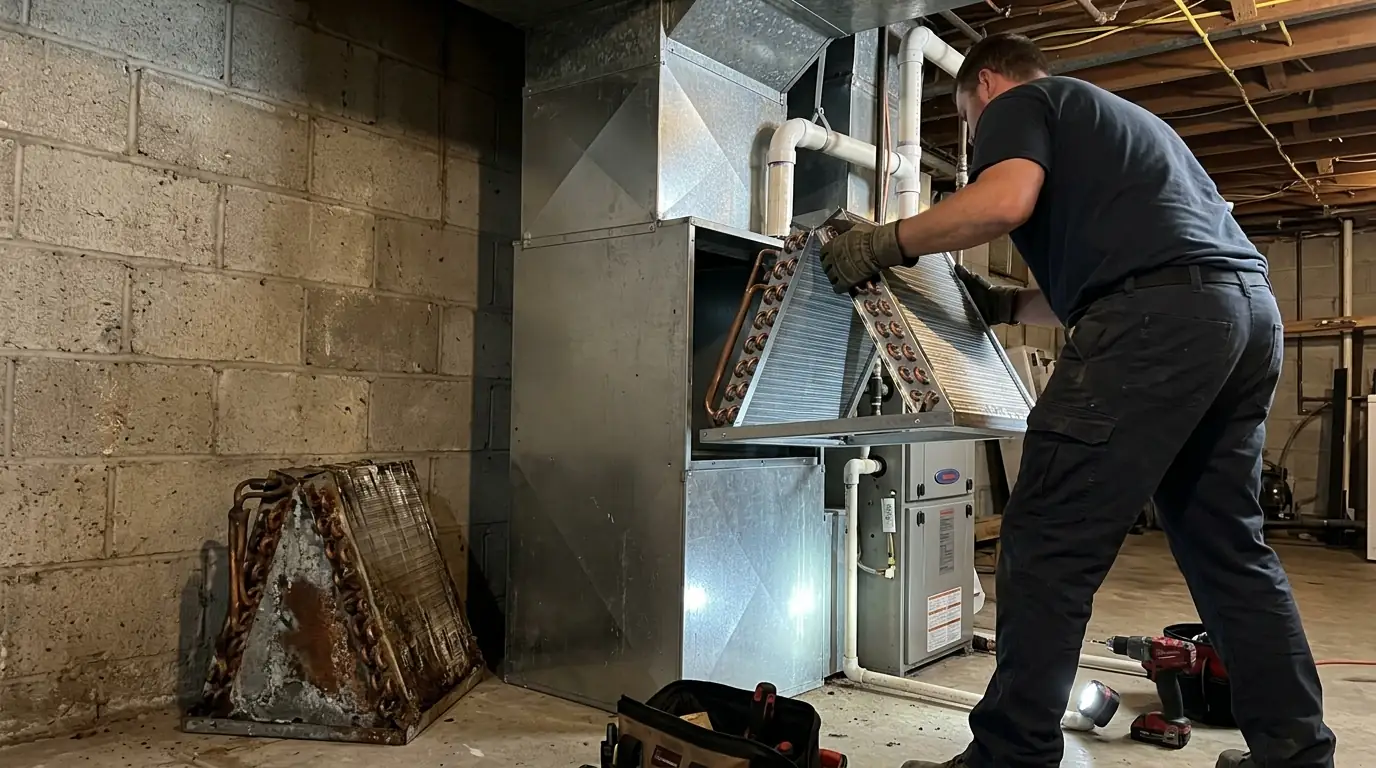
Evaporator coil replacement in Nashville is usually needed when pinhole corrosion makes the indoor coil leak refrigerant. The new coil has to match the condenser's capacity and refrigerant, so the model numbers decide the part. The job covers refrigerant recovery, brazing, a nitrogen pressure test, a deep vacuum and a weighed charge. Call (615) 412-2815 at any hour.
What happens to an indoor coil and how it gets replaced
The evaporator coil sits on top of the furnace or inside the air handler. It absorbs heat from the house air and pulls moisture out of it, so it spends every summer cold and wet. Over time, acids in that moisture eat at the tubes, and leaks follow.
Replacing it means recovering the refrigerant, cutting out the old coil, fitting the new one and its transitions, brazing the lines and resealing the cabinet against air leaks. We also check the drain pan and condensate line, since a new coil on a cracked pan only moves the problem.
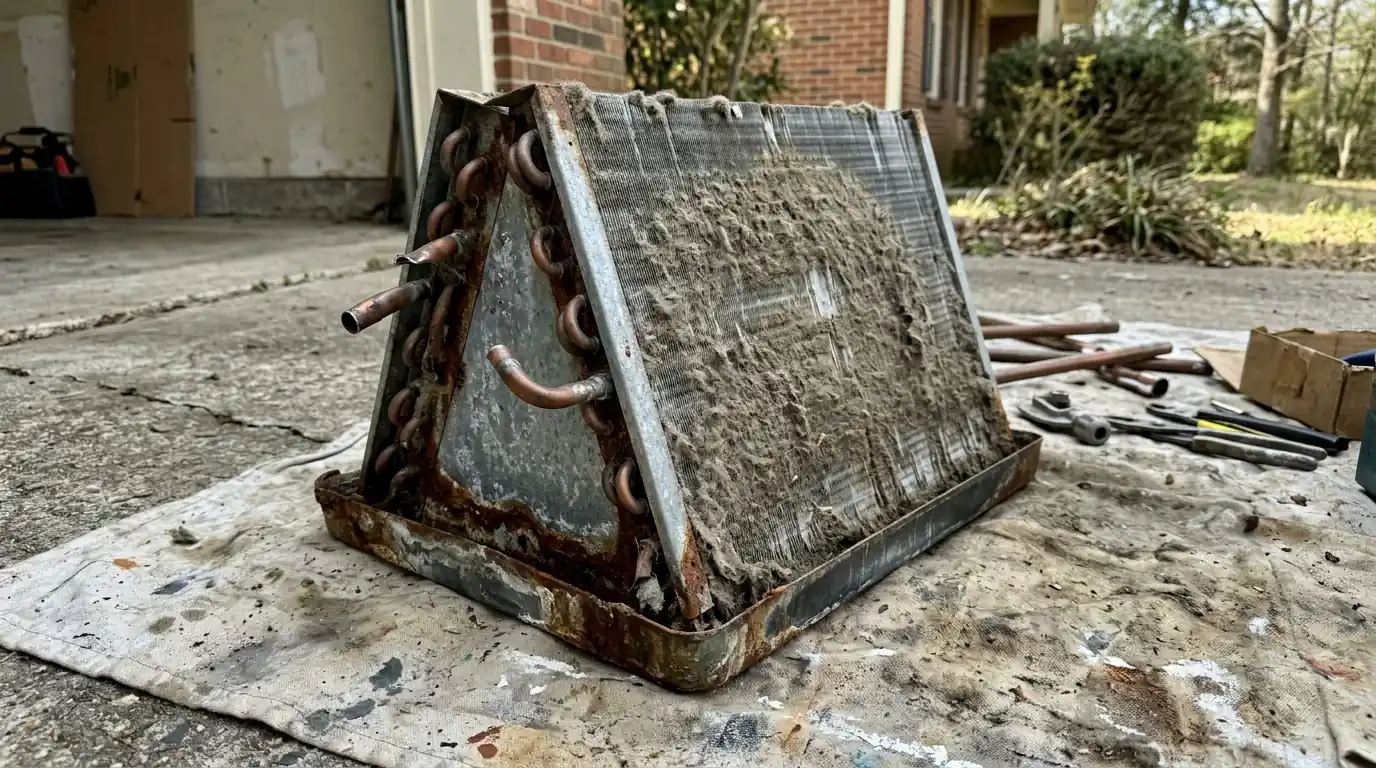
Cased coil replacement
Most gas furnace systems use a cased coil, a coil inside its own sheet metal cabinet that sits on the furnace supply opening. When the replacement has the same footprint, it drops into the same spot. When it is wider, taller or shaped differently, we build a new transition so air flows evenly across the whole coil.
Every seam between the furnace, the coil cabinet and the supply plenum gets sealed. An air leak there pulls in attic or crawl space air, and the cabinet can sweat. The new coil also gets a sound drain pan and a secondary drain or float switch.
Coil matching on older systems
A coil has to match the condenser in capacity and refrigerant. On an R-410A system that still runs well, a matched R-410A coil can keep it going, and we check the condenser model to find one rated for it. On an R-22 system, a new coil means converting or replacing, and that rarely pays off.
Coils built for R-454B can't be swapped onto an R-410A condenser. If the condenser is also near the end of its life, a matched condenser and coil may cost less over the next few years than a coil alone now.
New coil or new system: how the choice usually breaks
| Factor | Coil only | Coil and condenser |
|---|---|---|
| System age | Condenser is fairly young and runs well | Condenser is old or has had repairs |
| Refrigerant | Matched R-410A coil available | R-22 system, or moving to R-454B |
| Maker coverage | Coil still covered by the manufacturer | No coverage left on any part |
| Result | Same system, leak fixed | New matched system at its full rating |
What changes the cost of a new evaporator coil
HomeGuide lists evaporator coil replacement at $2,500 to $4,500 when the owner pays for the coil, and $1,000 to $2,500 when the manufacturer still covers the part; that is a national market range, not our quote.
- Manufacturer coverage. A coil still covered by its maker leaves mostly labor and refrigerant to pay.
- Size and match. Larger coils, and coils for less common condensers, cost more.
- Refrigerant. The system is recharged after the swap, and R-22 costs far more per pound.
- Transition work. A coil with a different footprint needs new sheet metal to fit the furnace.
- Access. Attic and crawl space coils take longer to remove and set than basement or closet coils.
Long Nashville hot spells are hard on the indoor coil
Nashville once logged 34 days in a row at 90 degrees or hotter, from July 26 to August 28, 2007, and 15 days that August reached 100 degrees or more. A coil in a stretch like that stays cold and wet for most of every day, with condensate on its tubes for weeks. That steady moisture is what feeds corrosion over many summers. So when we replace a coil, we also make sure the pan, the trap and the filter keep water and dirt off the new one.
How a coil swap runs, start to finish
- 1
Confirm the leak and the match
We verify the coil is the leak and find a replacement rated for your condenser.
- 2
Recover and remove
The refrigerant is recovered, the lines are cut and the old coil comes out.
- 3
Fit, braze and seal
The new coil and transitions go in, the lines are brazed under nitrogen and the cabinet is sealed.
- 4
Test and charge
A nitrogen pressure test and deep vacuum come before a weighed charge and a full cooling check.
How long the coil replacement takes
Once the replacement coil is in hand, most swaps take a day of work, including the pressure test and evacuation. A coil in a tight attic, or one that needs a new transition, can run longer.
The wait for the part depends on the coil. A common size is usually easier to get than an exact match for an older condenser, which may have to be ordered. We tell you which before we schedule.
Brands we work on
We service and install equipment from the major manufacturers, including Carrier, Trane, Lennox, Rheem, Goodman, American Standard, Daikin, Mitsubishi Electric, Bryant, Ruud, York and Amana.
Evaporator coil questions from Nashville homeowners
An electronic leak search and a bubble test at the coil show it. We confirm the leak location before recommending a coil.
Yes, if the condenser is healthy and a matched coil exists for it. On an older or R-22 system, we price a full replacement too.
An old pan may be rusted or cracked, and an uncased coil may need a pan that fits it. A leaking pan can soak the furnace or the ceiling below.
It restores what was lost to the leak and to dirty fins. It does not add capacity beyond what the condenser is rated for.
Often not. At that age the condenser and compressor are close behind, so a matched new system usually makes more sense.