Refrigerant leak repair in Nashville starts with finding the hole, because an AC never uses up its charge. A technician reads the pressures, searches with an electronic detector and bubble solution, and may pressure-test with nitrogen. Then you get the repair options and the price before the system is recharged. Call (615) 412-2815 at any hour.
Why a low charge always means a leak
Refrigerant circulates in a sealed loop. If the charge is low, it leaked out, and it'll keep leaking until the hole is found. Topping off a leaking system costs money every season, and in between the compressor runs hot and starved of returning oil.
Most leaks show up in a few places: the indoor coil, the brazed and flare joints at the service valves, the Schrader cores, and copper that rubs against a bracket or another line. We check those first, then widen the search.
Signs your AC is losing refrigerant
The system runs longer to reach the same setting.
A low charge drops the coil below freezing.
The air at the vents is not as cold as it used to be.
A steady hiss at the coil or lines can be escaping gas.
Refrigerant oil leaves a dark, dusty stain at the leak.
A system that needed refrigerant once will need it again.
Electronic leak search
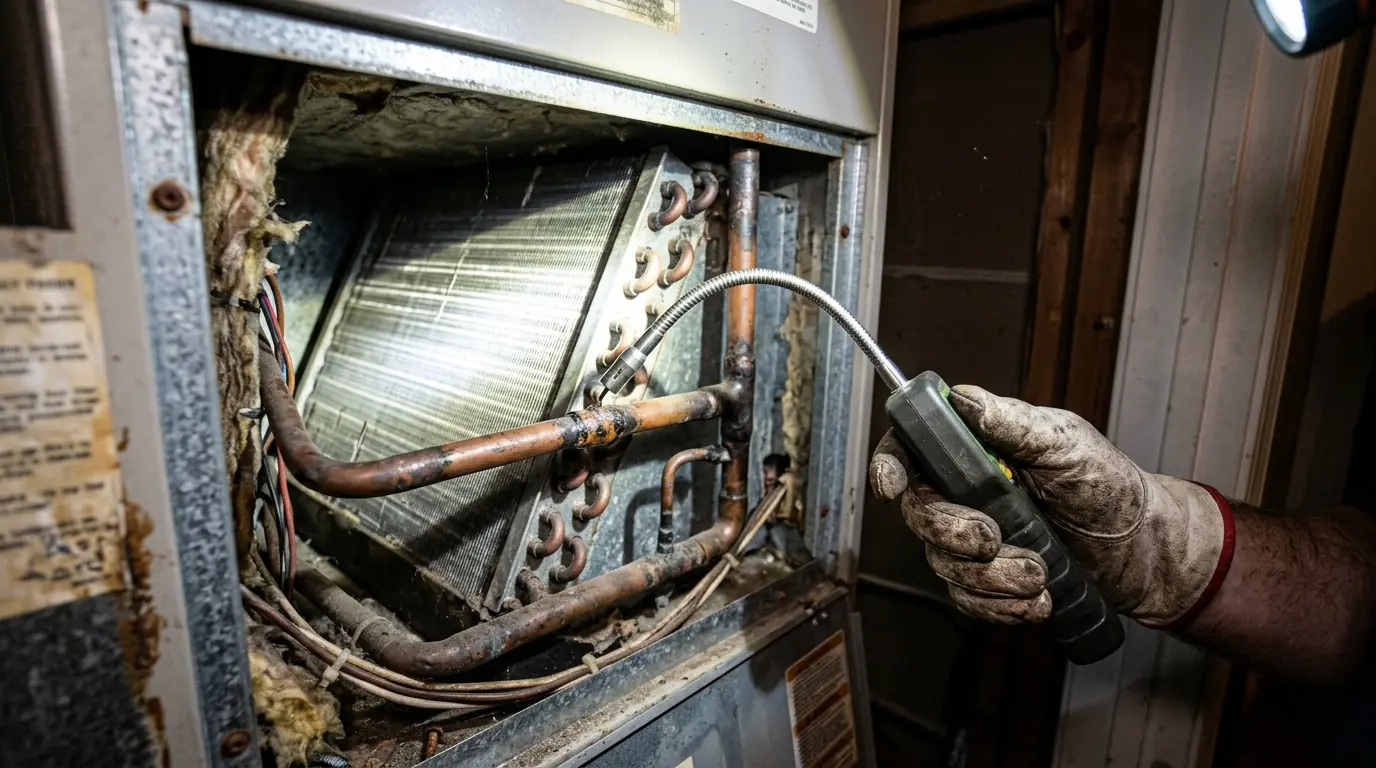
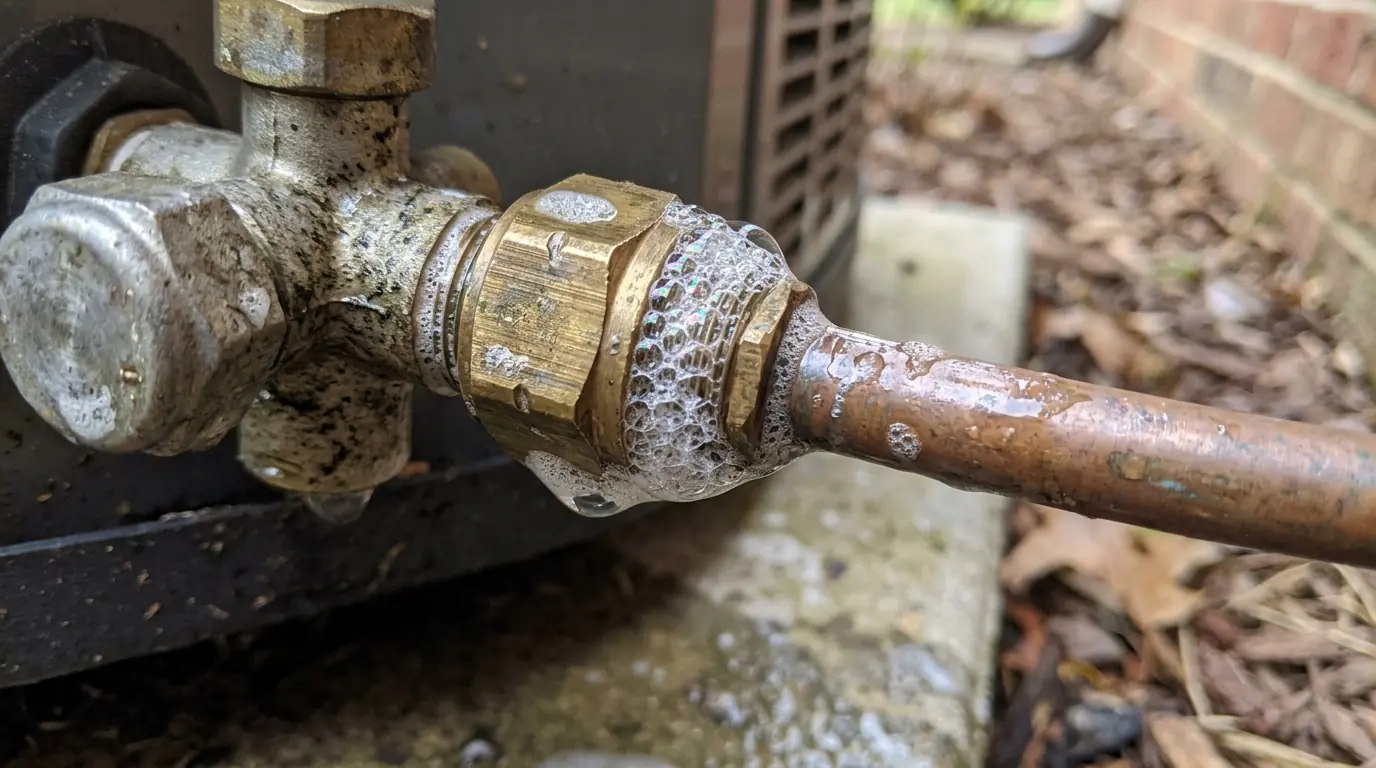
An electronic detector draws in air and alarms at a faint trace of refrigerant. We move it slowly along the coil, the line set and every joint, with the blower off so the trace is not swept away. A suspect spot gets confirmed with bubble solution.
When the system is nearly empty, we recover what is left and pressurize it with dry nitrogen, sometimes with a trace of refrigerant, so the leak can be heard, bubbled or detected. HomeGuide lists a leak detection test at $100 to $330.
Evaporator coil leaks
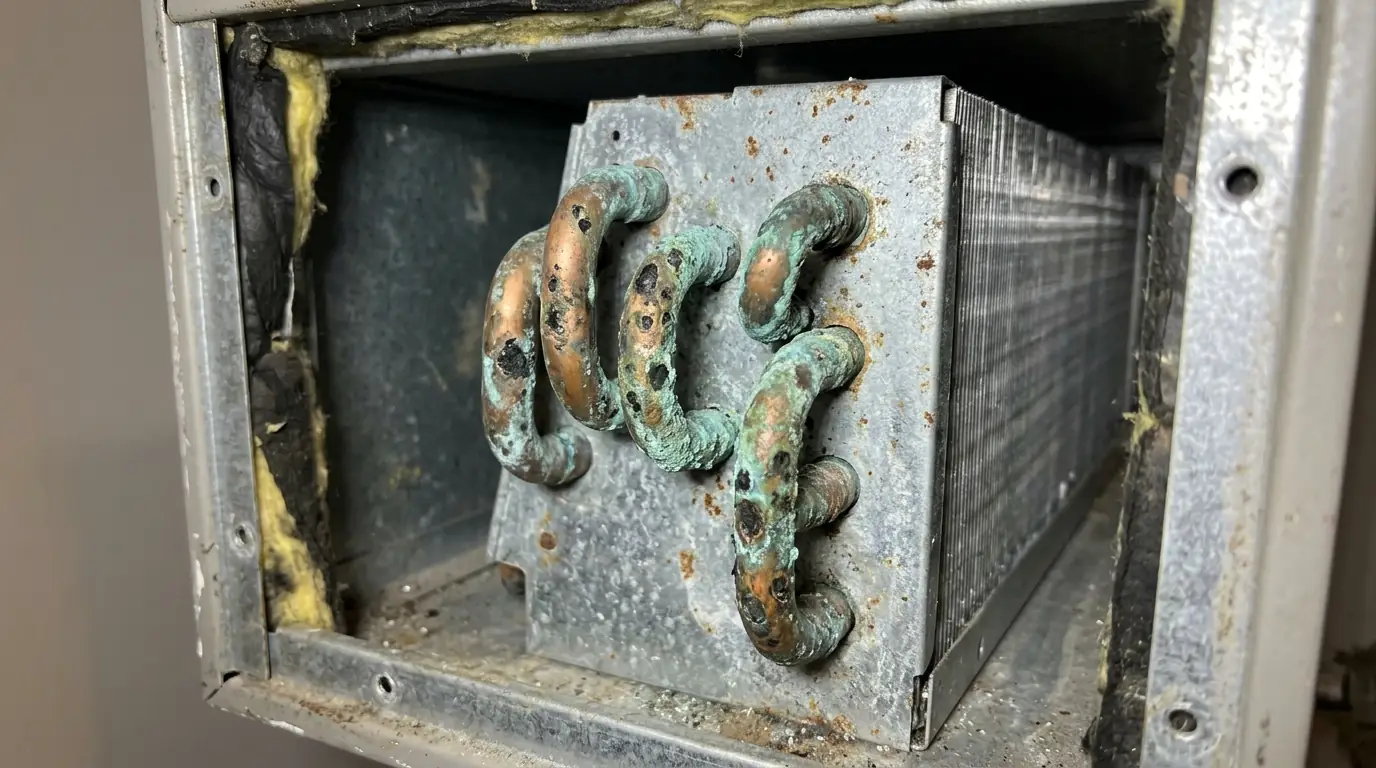
The indoor coil is the most common leak point on many systems. Its thin tubes sit in wet, slightly acidic condensate every summer, and corrosion leaves pinholes too small to see. The first sign is often a coil that freezes, or a system that slowly loses ground over a season.
A coil leak can sometimes be sealed at a reachable return bend. Pinhole corrosion across the coil usually means replacing the coil, and on an older system we price a full replacement alongside it.
Line set and fitting leaks
The copper lines between the indoor coil and the condenser can leak where they are brazed, where flare nuts loosen, or where a line rubs a wall bracket or the cabinet until it wears through. Schrader valve cores at the service ports leak too, and those are a small fix.
These leaks are usually repairable: a fresh braze, a new valve core with a sealed cap, or a short section of new copper. After the repair we pressure-test with nitrogen, pull a deep vacuum and weigh in the correct charge.
How long a leak search and repair takes
A simple leak at a valve core or flare fitting can often be found and fixed in one visit. Bigger searches take longer, especially when the leak only opens under the high pressure of a hot afternoon.
When we pressure-test with nitrogen, the system sits under pressure for a set time to see whether it drops. A coil replacement needs the part ordered and a second visit, and the system is evacuated before it is recharged.
From low charge to a sealed system
- 1
Read the pressures
Gauges, superheat and subcooling show whether the charge is low and roughly by how much.
- 2
Search and confirm
Electronic detection and bubble solution locate the leak, with nitrogen testing when needed.
- 3
Price the repair
You get the leak location, the repair options and the cost before work starts.
- 4
Repair, test and charge
After the fix, the system holds nitrogen pressure, is evacuated and is charged by weight.
Which refrigerant your Nashville system uses changes the math
As of January 1, 2025, new home air conditioners generally cannot use refrigerants with a global warming potential of 700 or more, so most manufacturers moved from R-410A to R-454B. That rule covers new equipment, not repairs, so an R-410A unit in Nashville can still be fixed and recharged. Older R-22 systems are a different story because that refrigerant is no longer produced. On an R-22 system, a large leak usually points toward replacement, and we price both.
What a leak repair costs depends on where the leak is
The search and the repair are priced separately, and the leak location sets most of the bill.
For planning, HomeGuide puts typical national pricing for this kind of job at $200 to $1,500 for the repair; $100 to $330 for a leak detection test (HomeGuide, August 2025). That is a market range, not our quote; the figure for your home comes after we see the equipment.
- Leak location. A valve core or flare fitting costs far less to fix than an evaporator coil.
- How hard it is to find. Small or intermittent leaks may need a nitrogen pressure test on top of the electronic search.
- Refrigerant type and amount. Recharging an R-22 system costs much more per pound than R-410A.
- Coil access. A coil in an attic or crawl space adds labor to any coil repair.
- System age. An older system with a coil leak may be a better candidate for replacement.
Refrigerant leak questions from Nashville homeowners
We can, but a low charge means a leak, and the refrigerant will leak out again. Finding and fixing the leak first costs less over more than one summer.
Common signs are longer run-times, ice on the large copper line, warmer air on hot afternoons and a hiss near the unit. Only gauges confirm it.
In a home system the amount is small and it disperses quickly. If you hear a steady hiss, turn the system off, air out the room and call.
Sometimes, if the leak is at a reachable joint. Pinhole corrosion across the coil usually means replacing it.
It varies with system size and line set length, and the factory charge is listed on the condenser nameplate. We charge by weight to that figure.