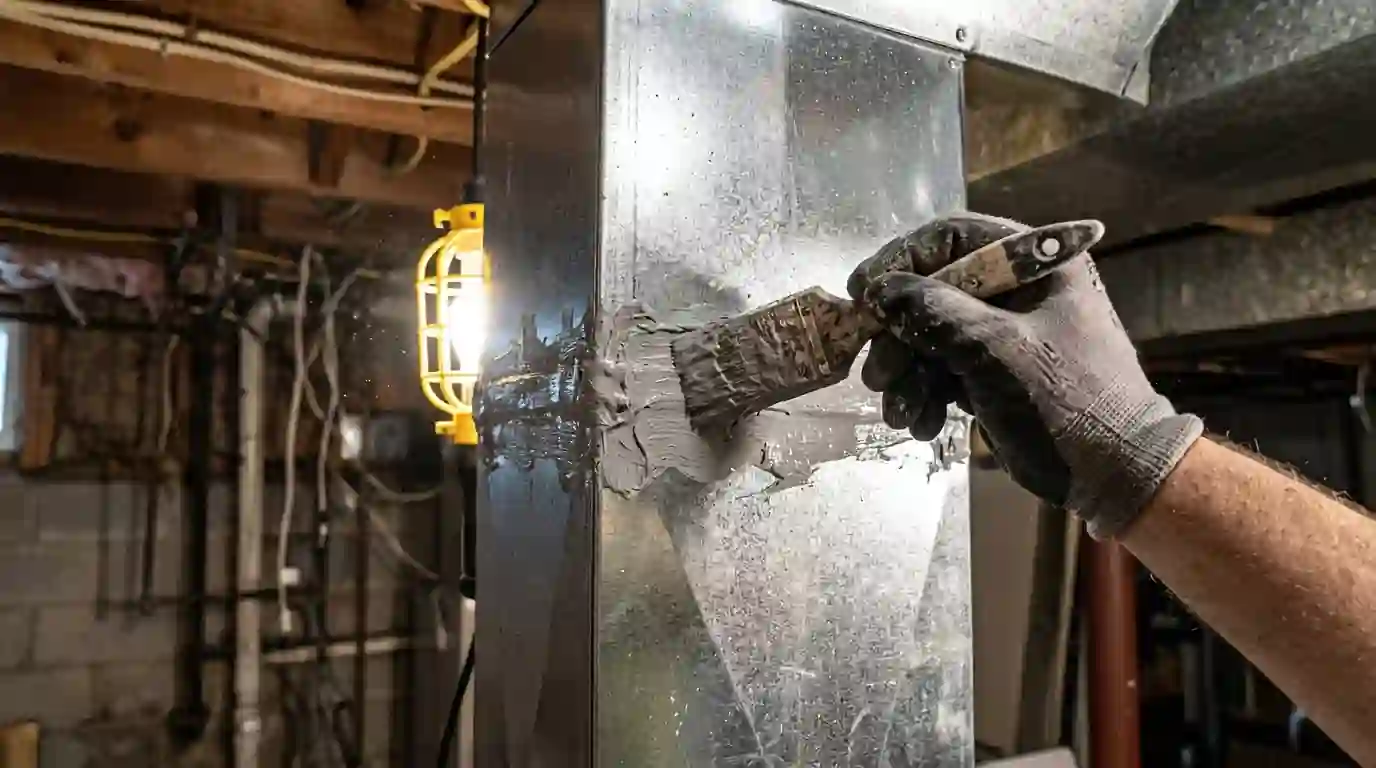
Duct repair and sealing in Nashville means reconnecting loose runs, replacing crushed sections and sealing joints with mastic, so the air you pay to heat or cool reaches the rooms. Leaks on the return side also pull in attic or crawl space air. We find the leaks with airflow readings and a full inspection, then price the repair. Call (615) 412-2815 at any hour.
Where ducts leak and how we find it
Ducts lose air at joints, boots and collars long before the duct itself wears out. Cloth tape dries and lets go, a flex run pulls off its collar, or a boot gaps where it meets the ceiling. Every leak on the supply side sends conditioned air into the attic or crawl space instead of the room.
We check airflow at the registers and static pressure at the equipment, then follow the ducts with a light. Disconnected and crushed runs get fixed first, because they are the biggest losses. Then the joints are sealed with mastic or foil tape rated for ducts.
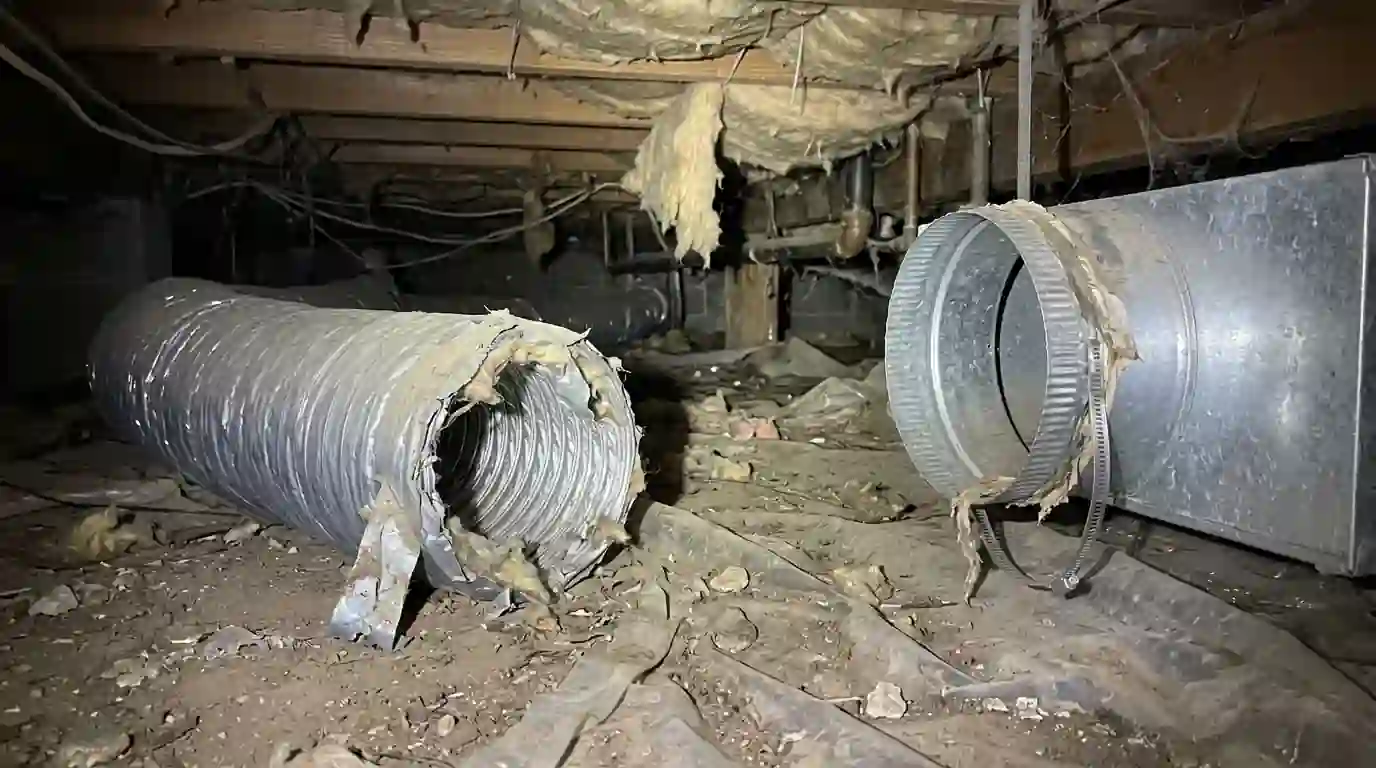
Disconnected and crushed ducts
A flex duct that has slipped off its collar blows conditioned air straight into the attic or crawl space, and the room it served gets almost nothing. Crushed runs are just as common: storage boxes in the attic, someone crawling over a duct, or a thin strap that cut through the jacket.
We reattach runs with new draw bands and mastic, replace crushed or torn sections, and rehang anything sagging so it runs straight. Where a run has been pinched for years, the inner liner is often torn too, so we replace it rather than reshape it. These fixes usually make the biggest difference in a lagging room.
Mastic sealing
Mastic is a thick paste brushed over duct joints, seams and boots. It stays flexible and holds for many years, which cloth duct tape does not; old tape dries out, curls and lets air escape. Foil tape rated for ducts works on some joints, but mastic covers uneven gaps better.
We seal the joints we can reach on supply and return ducts, with extra attention on the return side, since leaks there pull dusty, humid air into the system. Large gaps get mesh tape under the mastic. Sealing goes hand in hand with fixing disconnected runs, because mastic can't close a duct that's pulled apart.
Duct insulation
A cold supply duct in a humid crawl space or attic sweats if its insulation is thin, torn or missing. That water drips onto joists and insulation, and the duct wastes cooling before the air reaches the room. In winter, bare ducts lose heat the same way.
We wrap exposed metal ducts and plenums in foil-faced duct insulation, seal its seams so moisture cannot get behind it, and replace flex runs whose jackets have split. Insulation goes on after the joints are sealed, so the leaks are closed first. Ducts inside the conditioned part of the house usually do not need it.
What duct repair and sealing costs depend on
There is no single price, because the work scales with how much duct is reachable and how much is damaged.
- Reachable footage. Ducts in an open crawl space or attic are faster to seal than runs behind finished walls.
- Repairs versus sealing. Replacing crushed or torn runs adds material and time to joint sealing.
- Insulation needed. Wrapping bare metal ducts adds insulation and labor.
- Working conditions. Low crawl spaces, deep attic insulation and summer attic heat slow the work.
- Testing. Airflow and static pressure readings before and after show what the work achieved.
Sealing ranch-house ducts in Crieve Hall, and what TVA lists for it
Crieve Hall is mostly 1950s and 1960s brick ranch houses. A ranch layout usually runs its ducts through the attic or crawl space, with long branches out to the bedrooms at each end, and decades of failed tape and patchwork add up along those runs. TVA EnergyRight lists duct sealing among the upgrades that qualify for Middle Tennessee homeowners, alongside tune-ups and equipment rebates. The paperwork has to be filed by a contractor in its approved network, so check eligibility before the work starts.
How a duct repair and sealing visit runs
- 1
Measure first
We read static pressure and register airflow so there is a baseline.
- 2
Trace every run
We follow supply and return ducts through the attic and crawl space and mark each problem.
- 3
Repair, then seal
Loose and crushed runs are fixed first, then joints get mastic and exposed ducts get insulation.
- 4
Measure again
We repeat the readings and show you the difference at the registers.
What you can do about duct leaks yourself
A few checks are safe and useful. Work in tight crawl spaces and anything near the equipment is better left to us.
| Task | Safe to do yourself | Leave to a technician |
|---|---|---|
| Registers | Open every supply register and clear furniture off the returns. | Registers that stay weak with everything open. |
| Visible loose duct | Look in the attic or basement for runs that have fallen off. | Reattaching, strapping and sealing them. |
| Tape repairs | Skip cloth duct tape; it dries out and fails. | Mastic sealing at joints and boots. |
| Filter | Change it on schedule so the blower is not starved. | Return leaks pulling dust around the filter. |
Signs your ducts are leaking
A disconnected or crushed run starves that room of air.
Leaks make the system run longer to hold the set point.
Return leaks pull unfiltered dust from attics and crawl spaces.
Gaps at a boot or a pinched run can make air hiss or whistle.
Air drawn through a return leak carries those smells into the house.
Anything hanging, lying on the dirt or open at the end is losing air.
Duct sealing questions from Nashville homeowners
When ducts run through an attic or crawl space, leaks waste air you are paying to heat and cool. Sealing and reconnecting runs usually improves the rooms that lag.
Cloth duct tape dries out and lets go within a few years. Mastic or foil tape rated for ducts holds far longer.
Joints behind finished walls are hard to reach by hand. We seal what is reachable and tell you plainly what is not.
TVA EnergyRight lists duct sealing among its qualifying upgrades. The claim has to be filed by a contractor in its approved network, so confirm eligibility before work begins.
It helps if leaks or a disconnected run are the cause. If the ducts are undersized, zoning or a mini-split may be the better answer.