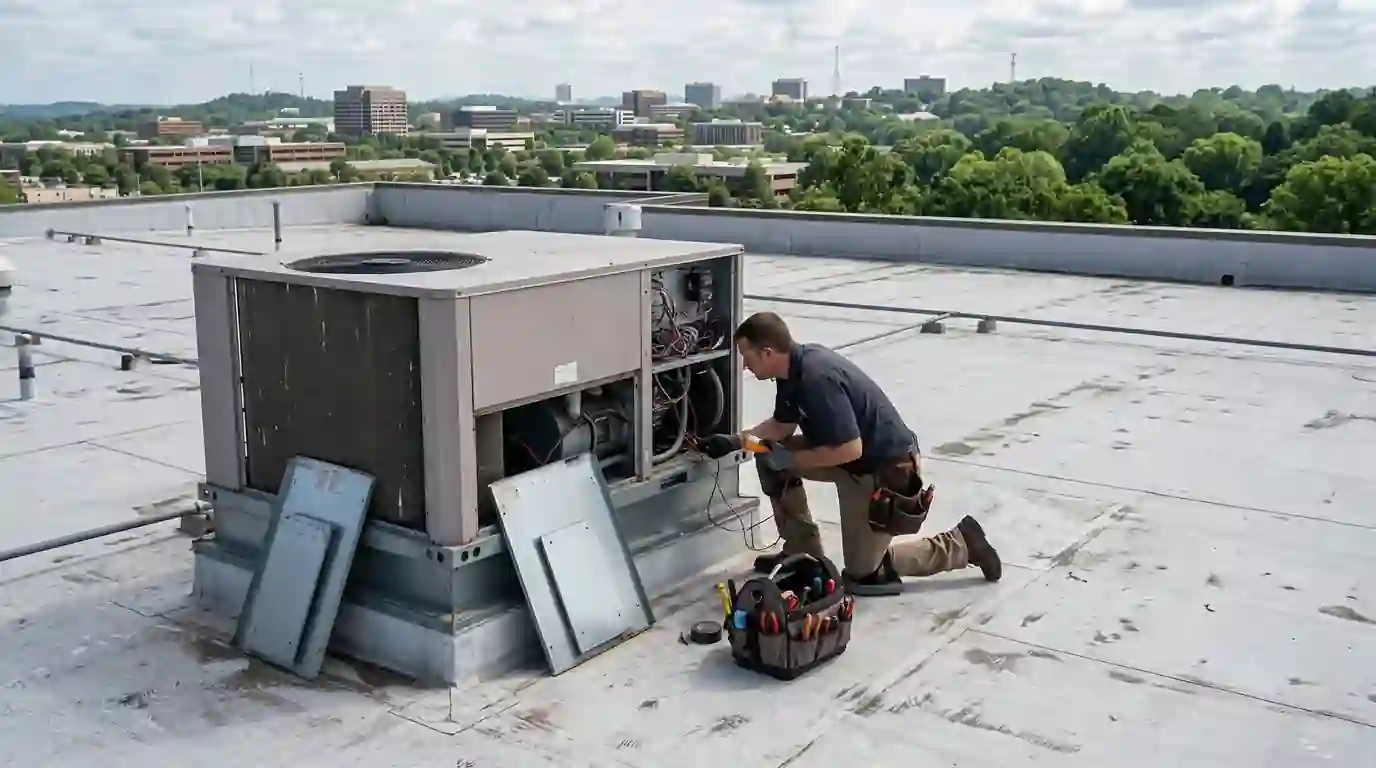
Commercial HVAC repair in Nashville mostly means packaged rooftop units and split systems on light commercial buildings such as shops, offices, clinics and restaurants. Common failures are compressors, condenser fan motors, blower belts, gas valves and economizer controls. We test the unit, price the fix and schedule the work around your hours. Call (615) 412-2815 at any hour.
What breaks on commercial equipment and how we find it
Light commercial equipment works like residential equipment at a larger scale, with a few extra parts. A rooftop unit packs the compressor, coils, blower and gas heat into one cabinet, and often adds an economizer that brings in outside air when it's cool enough. Belt drives, three-phase power and building controls are common, and each brings its own failures.
We take readings first: voltage on each leg, amp draw, refrigerant pressures, belt tension and the temperature split. You get the cause, the price and the expected downtime before work starts.
Signs a commercial unit needs repair
The blower runs but the supply air is not cooling the space.
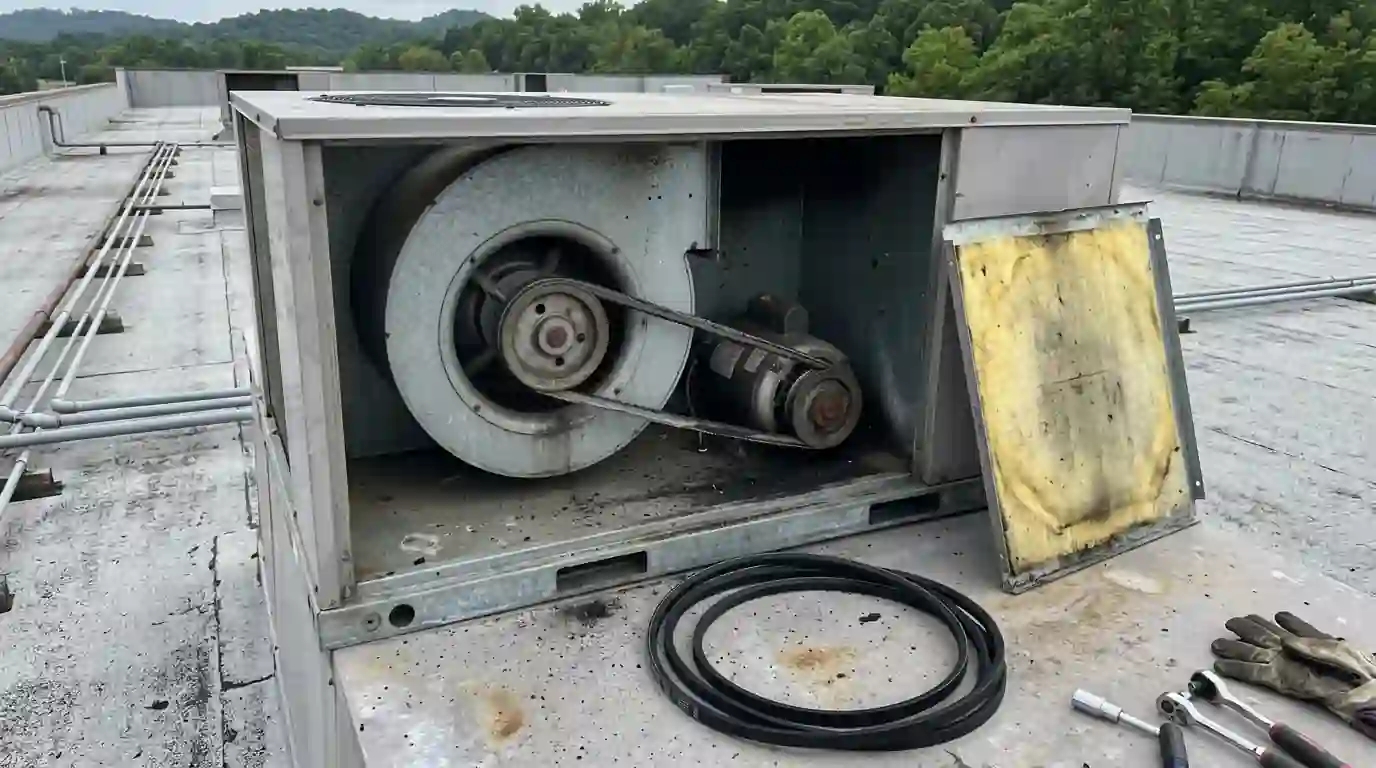
A slipping or glazed blower belt is close to breaking.
An economizer stuck open or a short cycling unit is not removing moisture.
A motor or compressor is drawing too much current or overheating.
A clogged drain or cracked pan is overflowing from the unit.
One unit or one stage may be down while the others carry the load.
Rooftop unit repair
Rooftop units sit in full sun on dark roofs, and that heat shortens the life of compressors, fan motors and control boards. A unit that runs but blows warm air may have a failed compressor, a dead condenser fan, or one cooling stage down while the other runs. No airflow at all often means a broken belt or a failed blower motor.
In winter, gas-fired units fail on igniters, flame sensors and limit switches. Economizers also stick open and flood the space with hot, humid outside air in summer, which looks like a cooling failure but is really a damper or sensor fault.
Restaurant and retail cooling
Restaurants run hot. Cooking lines, dish machines and a full dining room add heat and moisture that a unit sized only for floor area can't keep up with, and kitchen exhaust pulls air out of the building that has to be replaced. When a dining room turns sticky, we check whether make-up air and exhaust are balanced along with the cooling equipment.
Retail spaces bring their own loads: lighting, front doors opening all day and changing crowds. Grease on coils and filters is common near kitchens, so coil cleaning is often part of the repair.
How long commercial repairs take
Electrical failures, belts, motors and igniters are usually repaired on the first visit once the part is confirmed, because those are common sizes at local supply houses.
Compressors, heat exchangers and model-specific control boards take longer, since parts may need to be ordered and a lift or crane may be needed to reach the unit. We'll give you the expected downtime with the price so you can plan staffing and hours.
How a commercial repair call runs
- 1
Describe the problem
Tell us which unit, what the space is doing and when it started.
- 2
Diagnose on site
We take electrical, refrigerant and airflow readings at the unit and the thermostat.
- 3
Price and schedule
You get the repair, the cost and the downtime before work begins.
- 4
Repair and verify
After the fix we run every stage and check supply air temperature in the space.
Keeping Nashville storefronts cool through long summers
Commercial cooling in Nashville has to handle long, humid summers, and a building full of customers, lights and kitchen equipment adds load that a house never sees. Rooftop units take direct sun on flat roofs, so their compressors and condenser fan motors run hotter than equipment set on the ground. Humidity matters as much as temperature: a unit that cools but cannot dry the air leaves floors and glass sweating. In winter, gas heat sections and heat pump defrost controls take their turn.
What moves the price of a commercial repair
Commercial repairs vary more than residential ones because the equipment, the access and the timing vary more.
- Unit size and type. Larger tonnage and three-phase equipment use bigger and costlier parts.
- Roof access. A unit reached only through a ladder hatch, or one that needs a lift, takes longer to service.
- Failed component. A belt or contactor is a small repair, while a compressor or heat exchanger is a major one.
- Refrigerant type. Older units on R-22 cost more to recharge, which can tip the decision toward replacement.
- After-hours work. Nights, weekends and holidays can carry a higher service rate than regular hours.
Brands we work on
We service and install equipment from the major manufacturers, including Carrier, Trane, Lennox, Rheem, Goodman, American Standard, Daikin, Mitsubishi Electric, Bryant, Ruud, York and Amana.
Commercial repair questions from business owners
Yes. Packaged rooftop units are the most common light commercial equipment we work on.
Yes. The phone is answered 24/7, and repairs can be planned for after hours so the business stays open.
Kitchen exhaust pulling in unconditioned air, an economizer stuck open or an oversized unit short cycling are the usual causes.
A belt, motor or control repair usually makes sense. A compressor or heat exchanger failure on an older R-22 unit usually points to replacement.
Yes, including condensers on the ground or roof feeding air handlers above ceilings and in mechanical closets.