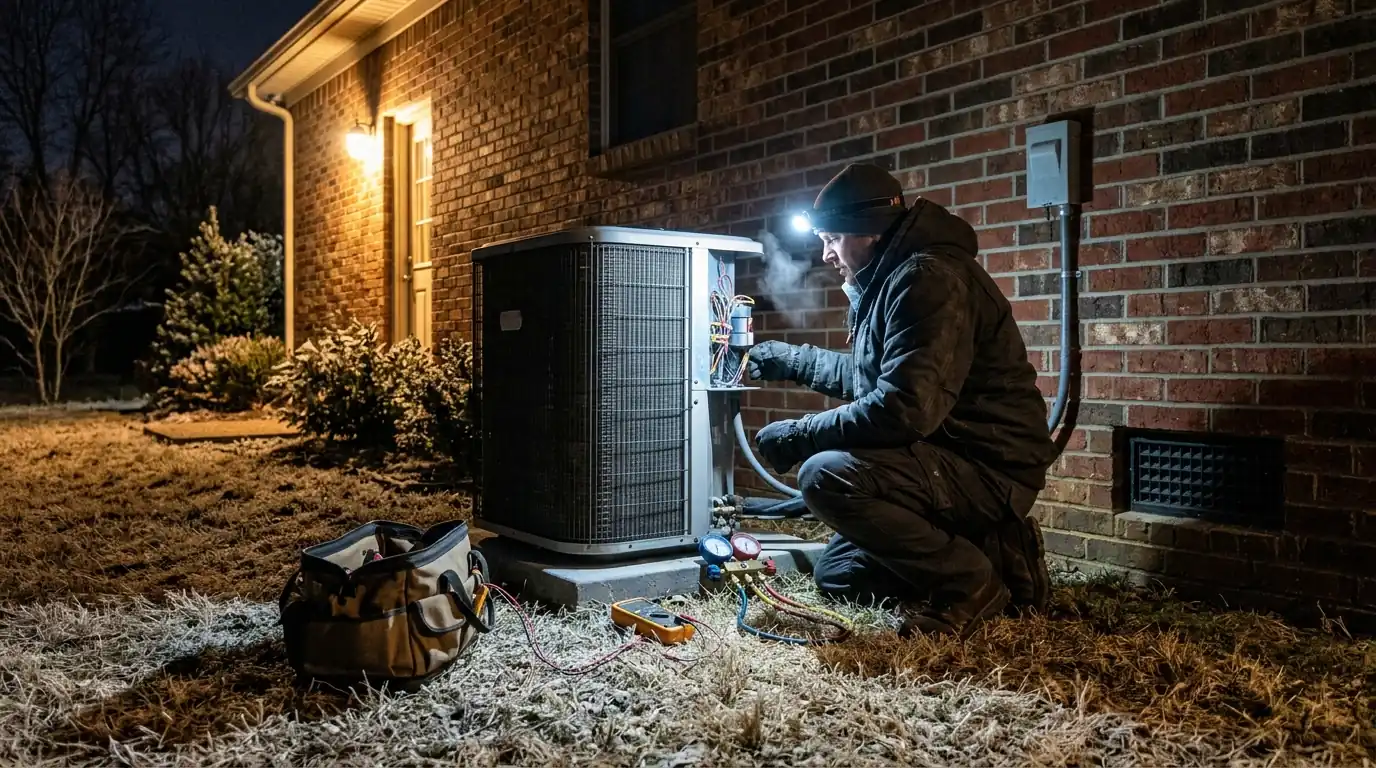
Emergency HVAC repair in Nashville covers no heat, no cooling, burning smells, water leaks and systems that will not restart after an outage, at any hour. The phone is answered 24/7. A technician tests the system, gives you the cause and the price, and makes the repair once you approve. Call (615) 412-2815 at any hour.
What happens when you call after hours
An emergency call gets the same testing as a scheduled one. We measure before replacing anything, because a part swapped on a guess at 2 a.m. is still the wrong part. Most no-heat and no-cooling calls trace to a capacitor, a motor, an igniter or flame sensor, a control board, a tripped safety switch or a clogged drain.
When you call, we ask what the system is doing and walk through a few safe checks with you. Sometimes a breaker, a thermostat setting or a float switch gets it running, and then you don't need a night visit at all.
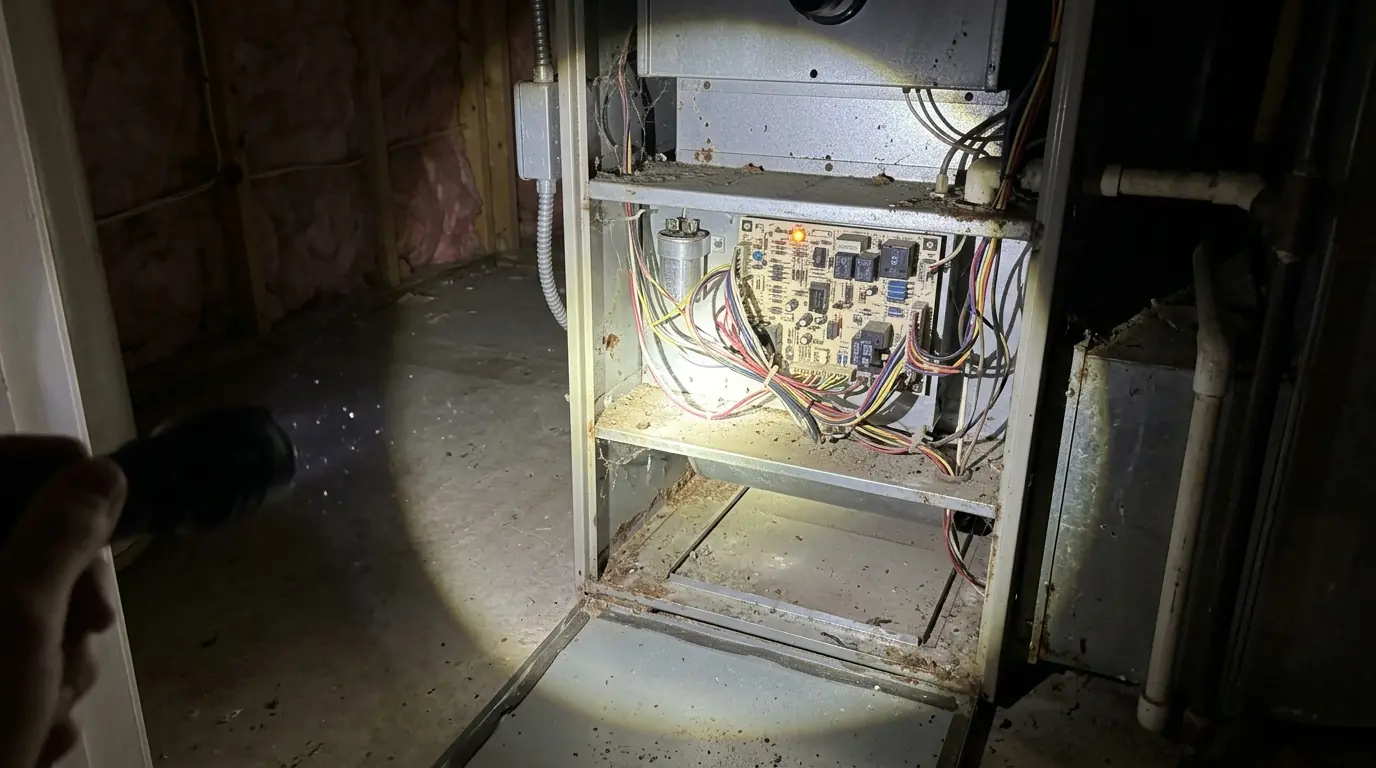
When a heating or cooling problem cannot wait
Especially with infants, older adults or anyone with health concerns in the house.
Indoor heat building through the afternoon is a health risk for some people.
Turn the system off at the thermostat and the breaker, then call.
Leave the house and call the gas utility from outside before calling us.
An attic drain overflow can soak drywall fast, so shut the system off.
Repeated trips mean a motor or compressor problem that resetting will not fix.
No heat at night
The house is cooling down, the thermostat calls for heat, and nothing warm comes out. On a gas furnace the usual causes are a dirty flame sensor, a failed igniter, a tripped pressure or limit switch, or a clogged filter. On a heat pump, it's often an iced outdoor coil or a failed strip or sequencer in the air handler.
If you have a heat pump, switching to emergency heat may keep the house warm until the repair. If you smell gas, leave the house and call the gas utility first.
No cooling in a heat wave
In a long heat wave the outdoor unit runs for hours without a break, and the weakest part gives out: a capacitor, a contactor, the outdoor fan motor, or a coil so dirty the system trips on high pressure. Indoors, a clogged drain can trip the float switch and shut the system off.
Turn the system off if the copper line is iced, and run the fan alone so the ice melts. Close blinds on the sunny side and keep doors shut. We test the electrical parts and the charge before replacing anything.
After a power outage
When the power comes back, the system may sit dead because a breaker or the outdoor disconnect tripped, a low-voltage fuse blew, or the board locked out after a surge. Brownouts and repeated on-off cycles are hard on compressors and capacitors.
Set the thermostat to off for a few minutes after the power returns, then turn it back on so the compressor is not started against high pressure. Reset a tripped breaker once. If it trips again, or the outdoor unit hums without starting, leave it off and call.
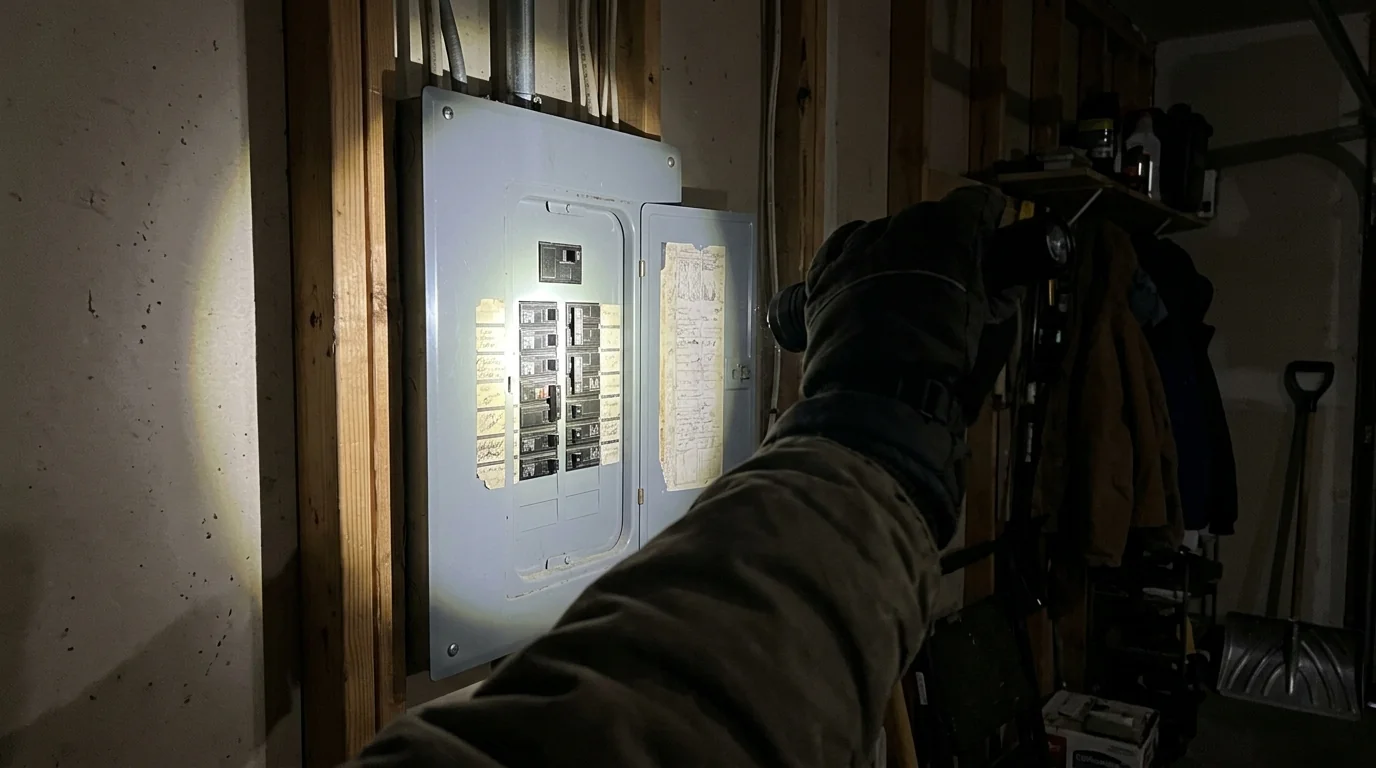
How long an emergency repair takes on site
Most emergency repairs are one-visit jobs. A capacitor, contactor, igniter, flame sensor, fuse or drain clearing usually takes an hour or two after the fault is found.
Bigger failures take longer. A motor, a control board or a refrigerant leak may need a part that has to be ordered for your model. When that happens, we tell you at the visit and set up whatever temporary heat or cooling the equipment allows, such as emergency heat on a heat pump.
How an emergency call runs
- 1
A person answers
Tell us what the system is doing, and we walk through safe checks first.
- 2
Set the visit
If the checks do not fix it, we set the visit and tell you what to have ready.
- 3
Test and price
The technician measures, names the failed part and gives you the cost before work starts.
- 4
Repair and confirm
We run the system through a full cycle and confirm heat or cooling at the vents.
The heat waves and blackouts behind Nashville emergency calls
Nashville's all-time high of 109 degrees came on June 29, 2012, inside a run of near or above 100 degree days from June 28 to July 8. A stretch like that is when capacitors and fan motors quit. Winter brings its own trouble: on December 23 and 24, 2022, TVA ordered rolling blackouts across Tennessee, and NES, Middle Tennessee Electric and Cumberland Electric customers saw 10 to 30 minute cuts in deep cold. Repeated restarts like those trip breakers and lock out control boards.
What an emergency HVAC repair costs
After-hours rates add to the repair itself, and the failed part sets the rest.
For planning, HomeGuide puts typical national pricing for this kind of job at $160 to $250 an hour for nights, weekends and holidays; service call fees of $75 to $200 (HomeGuide, August 2025). That is a market range, not our quote; the figure for your home comes after we see the equipment.
- Time of the call. Nights, weekends and holidays usually carry a higher rate than weekday hours.
- The failed part. A capacitor or flame sensor costs far less than a motor, board or compressor.
- Refrigerant work. A leak repair and recharge adds recovery, testing and refrigerant cost.
- Access. Attic and crawl space equipment takes more labor than a closet or basement unit.
- Whether it can wait. Some fixes can be made safe at night and finished at a weekday rate.
Emergency heating and cooling questions
Yes. The phone is answered 24 hours a day, every day, including weekends and holidays.
It can be, in a heat wave or with someone in the house who is vulnerable to heat. If not, a daytime visit may cost less.
For no heat, use emergency heat on a heat pump if it works, and close off unused rooms. For no cooling, run fans, close blinds and turn the system off if the line is iced.
Check the breaker and the outdoor disconnect, set the thermostat to off for a few minutes, then back on. If a breaker trips again, leave it off and call.
Night, weekend and holiday calls usually carry a higher rate. You get the price before any work starts.
Leave the house, call the gas utility from outside, and do not operate switches. Call us once the gas utility has cleared it.