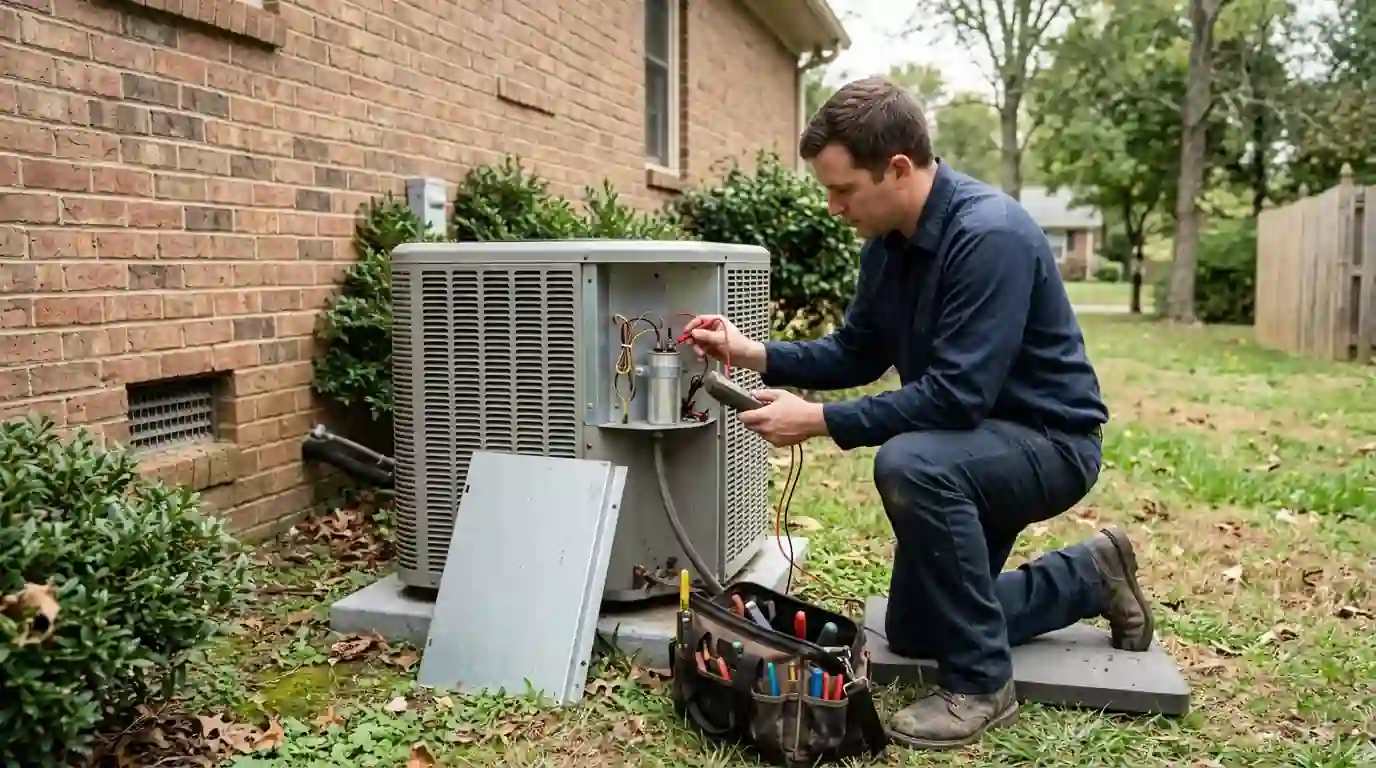
Most Nashville AC repairs come down to five parts: the run capacitor, the contactor, the outdoor fan motor, a refrigerant leak or a clogged condensate drain. A technician tests each one with meters and gauges, gives you the repair and the price, and fixes it once you approve. Call (615) 412-2815 at any hour.
What an AC repair visit actually checks
An air conditioner that stops cooling is rarely a mystery once someone measures it. We check voltage, the capacitor against its label, amp draw, refrigerant pressures and the temperature split across the indoor coil. Those readings point at the failed part on nearly every call.
You get the finding and the price before any part comes out of the box. On an old system facing a large repair, we price replacement alongside it.
Signs your air conditioner needs a repair visit
The blower runs but the air is no cooler than the room.
A hum with no fan or compressor start often points to a capacitor or contactor.
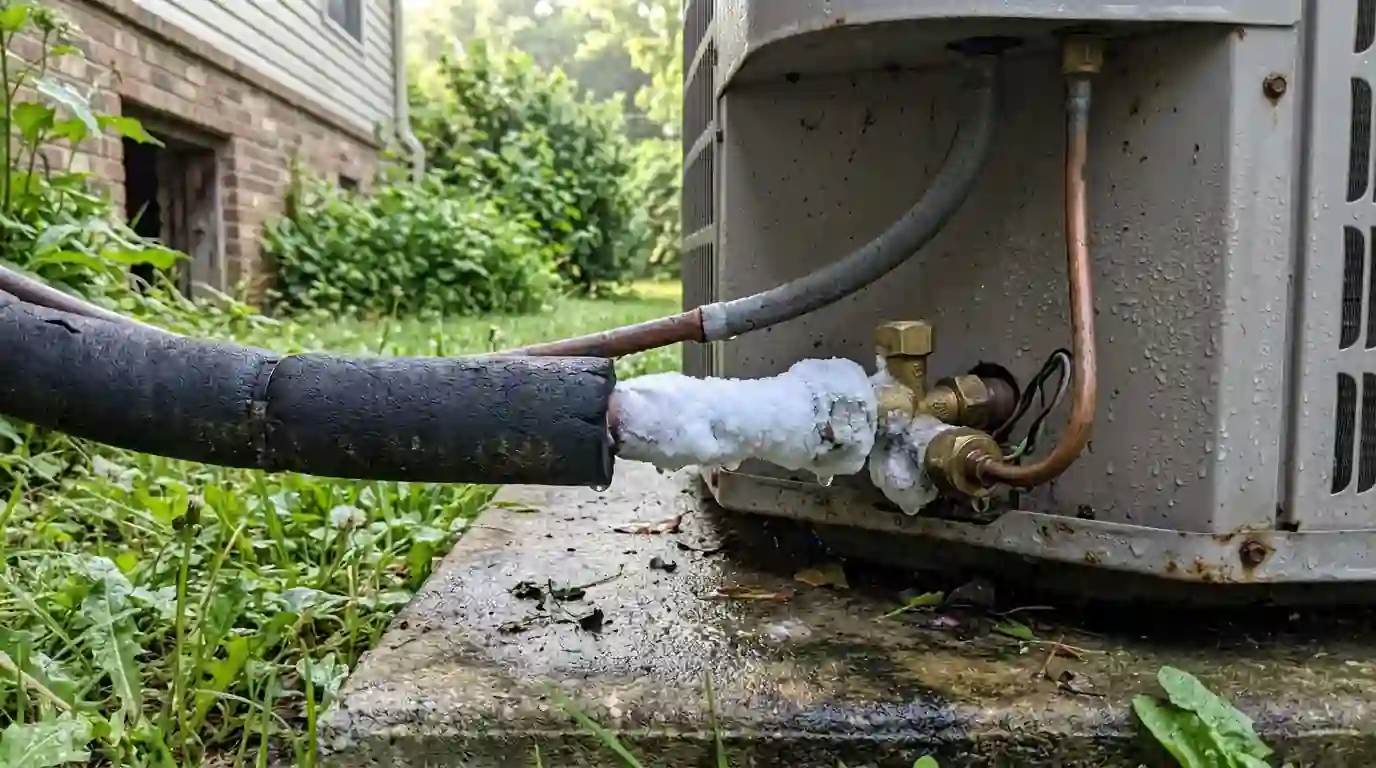
Frost on the large line means low airflow or low refrigerant.
A clogged drain or a melting coil can overflow the pan.
The system starts and stops every few minutes instead of running steadily.
Repeated trips usually mean a motor or compressor is drawing too much current.
AC not cooling or blowing warm air
The fan runs inside but the air coming out is room temperature. Outside, the condenser may be silent, humming, or running with its fan stopped. That pattern usually means the compressor is not starting, and the cause is most often electrical: a weak capacitor, a pitted contactor or a tripped breaker.
We confirm which by measuring, not by swapping parts until the air turns cold. A clogged filter or a dirty outdoor coil can also starve the system on a 95-degree afternoon, so we look at both before calling it a part failure.
Frozen evaporator coil
Frost on the large copper line at the outdoor unit, or water pooling under the indoor unit after the ice melts, means the evaporator coil is freezing. Low airflow from a blocked filter or a failing blower is one cause. Low refrigerant from a leak is the other.
Turn the cooling off and run the fan alone so the ice melts before we arrive. Running a frozen system can push liquid refrigerant back to the compressor, which is the part you least want to replace.
Capacitor and contactor failure
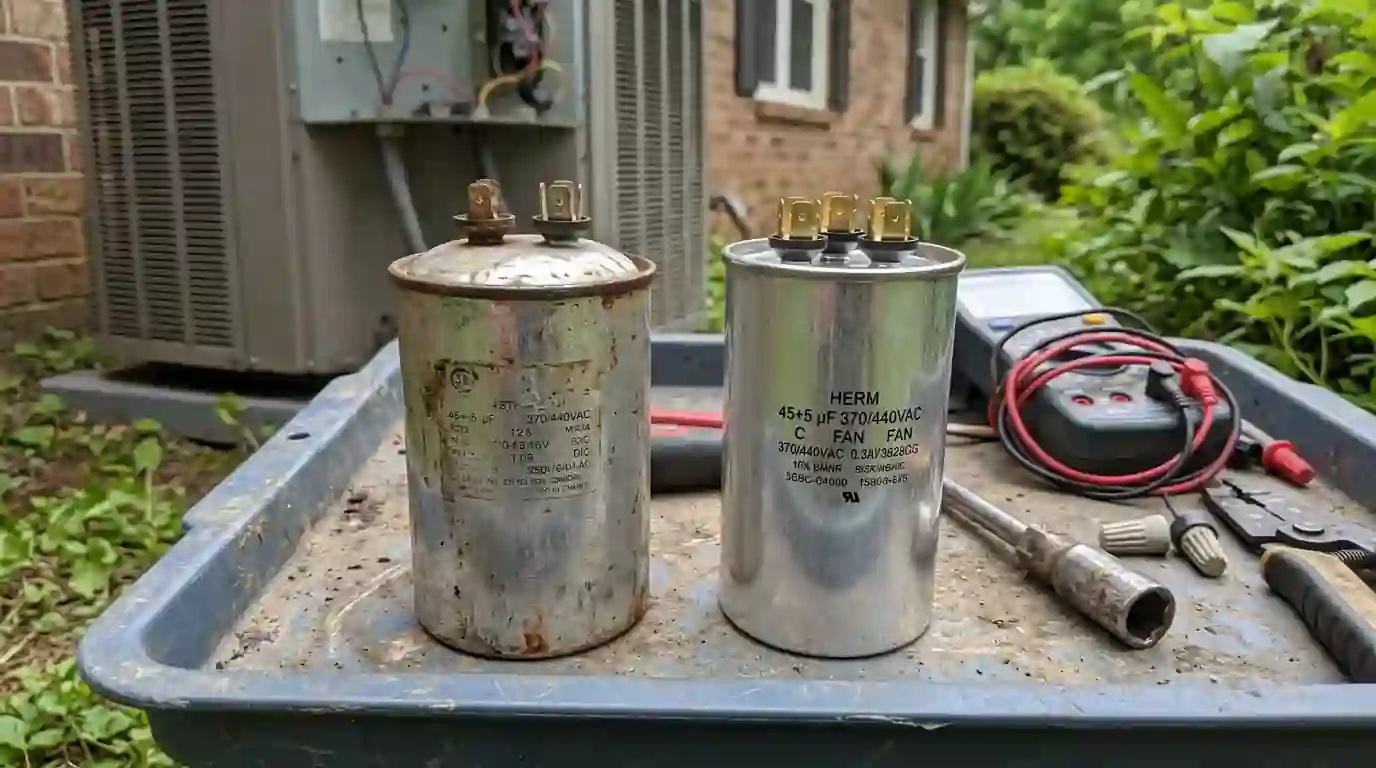
The run capacitor gives the compressor and fan motor the push they need to start. After weeks of long run-times it weakens, bulges at the top or reads well under its rated microfarads. The contactor is the switch that sends power to the outdoor unit, and its contacts pit and stick with age.
Both are common, quick repairs. HomeGuide lists capacitor replacement at roughly $100 to $250 in its cost table. We check that the compressor and fan motor are healthy before calling it done.
Outdoor fan motor replacement
If the compressor runs but the fan blade on top of the condenser does not turn, the unit cannot reject heat. Pressures climb, the compressor overheats, and the system shuts itself off on its safety limit, often after only a few minutes.
Sometimes the motor is fine and only its capacitor has failed, which is the cheaper fix. When the motor bearings are worn or the windings are open, we fit a matching replacement motor and blade, then check the amp draw against the nameplate.
How an AC repair call runs from first ring to cold air
- 1
Describe the symptom
Tell us what the system is doing and whether there is ice or water.
- 2
Measure before guessing
The technician checks voltage, capacitor values, amp draw, pressures and the temperature split across the coil.
- 3
Price first
You get the failed part, the cost and, on an older unit, the replacement option before any work starts.
- 4
Repair and retest
After the fix we run a full cooling cycle and confirm the supply air is cooling properly at the vents.
Why Nashville summers wear these parts out
Nashville set its all-time high of 109 degrees on June 29, 2012, in a stretch when Middle Tennessee ran near or above 100 degrees for more than a week. Heat like that keeps a condenser running for hours without a break, and the run capacitor and fan motor take the strain first. So a unit that started fine in May often quits in the first long July heat wave, and we test those two parts on nearly every summer call.
What you can check before you call
A few checks are safe and sometimes solve the problem. Refrigerant and wiring wait for a technician.
| Task | Safe to do yourself | Leave to a technician |
|---|---|---|
| Air filter | Replace it if it is gray or clogged. | If the coil is already iced over. |
| Thermostat | Confirm it is set to cool and below room temperature. | Wiring or a blank display. |
| Breaker | Reset a tripped breaker once. | Any breaker that trips again. |
| Outdoor coil | Clear leaves and gently rinse from inside out with the power off. | Bent fins, refrigerant smell or oil stains. |
What an AC repair costs and why it varies
The bill is set mostly by the part that failed and how hard it is to reach.
For planning, HomeGuide puts typical national pricing for this kind of job at $150 to $650, about $360 on average (HomeGuide, August 2025). That is a market range, not our quote; the figure for your home comes after we see the equipment.
- The failed part. Capacitors and contactors cost far less than a coil, a compressor or a leak search.
- Refrigerant type. Systems still running R-22 cost more to recharge because that refrigerant is no longer produced.
- Access. An air handler in a tight attic or crawl space adds labor compared with one in a hall closet.
- Equipment age. Older units may need hard-to-find parts, or may not justify a large repair.
- Time of the call. Night, weekend and holiday visits can carry a higher service rate than a weekday appointment.
Brands we work on
We service and install equipment from the major manufacturers, including Carrier, Trane, Lennox, Rheem, Goodman, American Standard, Daikin, Mitsubishi Electric, Bryant, Ruud, York and Amana.
AC repair questions from Nashville homeowners
The most common causes are a failed capacitor, a dirty outdoor coil, low refrigerant from a leak or a clogged filter. Each leaves different readings, so we test before adding refrigerant.
No. Switch the thermostat to off, set the fan to on, and let the ice melt. Running a frozen coil can damage the compressor.
Yes, but R-22 is no longer made, so recharging is costly and we price a replacement alongside the repair.
Yes. The phone is answered 24 hours a day, every day, including weekends and holidays.
A small electrical repair usually is. A failed compressor or coil at that age usually is not.