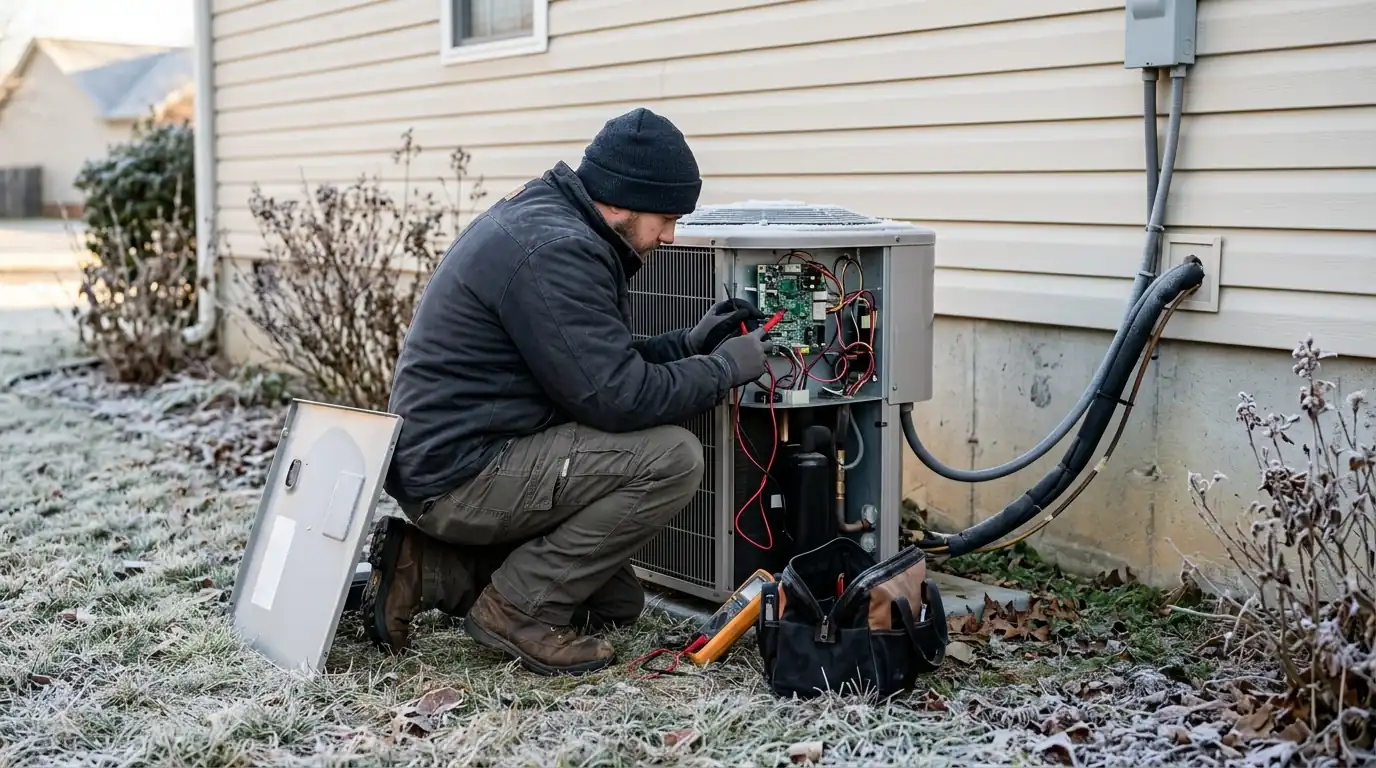
Heat pump repair in Nashville usually traces to one of four faults: a defrost board or sensor that fails to clear ice, a reversing valve stuck in one mode, a weak capacitor, or low refrigerant from a leak. A technician measures each, explains the failed part and its price, and repairs it once you approve. Call (615) 412-2815 at any hour.
What we measure on a heat pump that is not heating
A heat pump does two jobs with one refrigerant circuit, so a fault can hide in either mode. We read coil and supply temperatures, pressures and amp draw, then force a defrost cycle. Those numbers separate a control problem from a refrigerant or compressor problem.
You'll get the finding and the price before work starts, and on an old system facing a large repair, a replacement price alongside it.
Signs your heat pump needs a repair visit
Aux heat stays on long after a cold morning warms up.
The outdoor coil stays white or solid after defrost.
The vents blow cool air for more than a few minutes.
The unit starts and stops every few minutes.
The compressor hums but the fan on top sits still.
A winter bill far above last year often means the strips are carrying the house.
Stuck in auxiliary heat
The thermostat shows aux or emergency heat for hours, the air feels hot and dry, and the next power bill jumps. Aux heat is the electric strip heater in the air handler. It should help the heat pump on cold mornings and during defrost, not carry the house.
When it runs constantly, the heat pump itself is usually not doing its share: low charge, a failed outdoor fan, a stuck reversing valve or a thermostat set up with the wrong staging. We check the outdoor unit first, then the thermostat wiring and settings.
Outdoor coil iced over
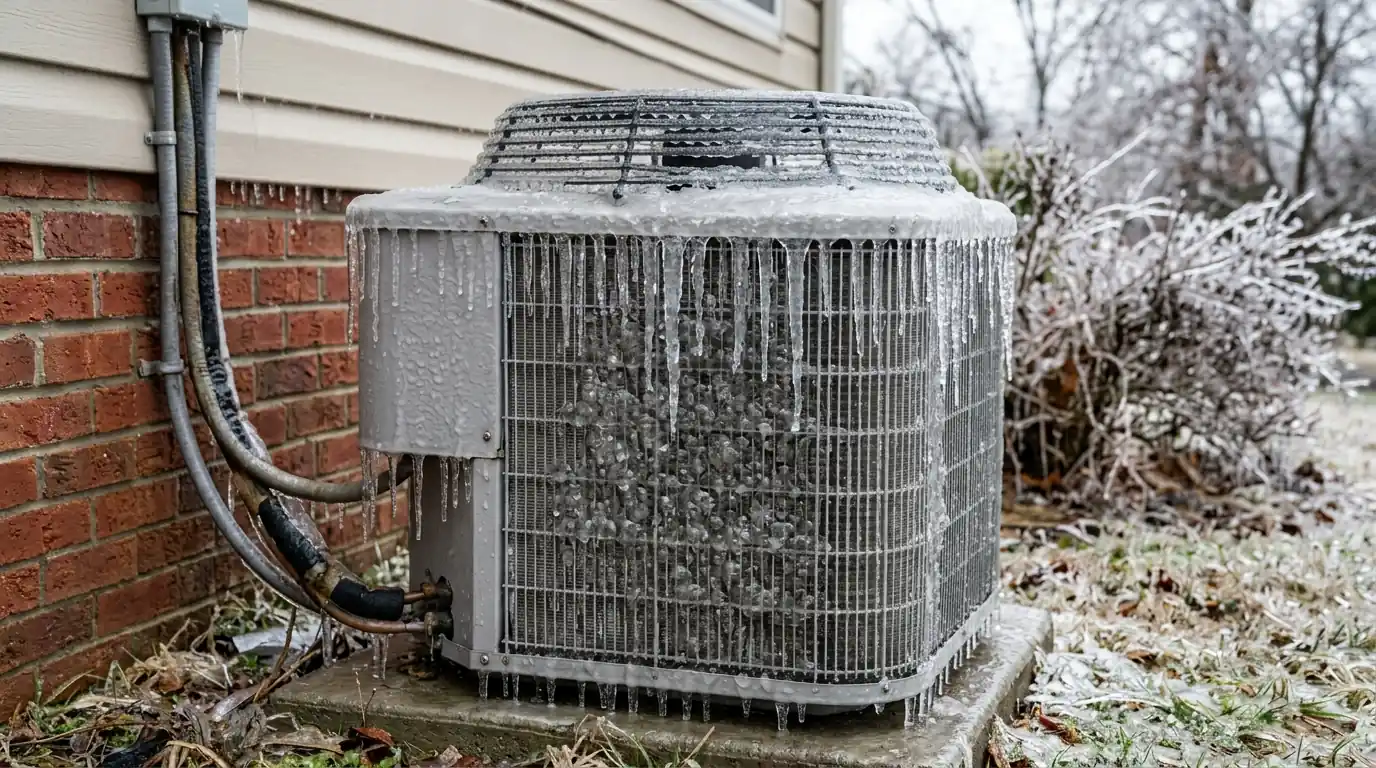
A light coat of frost on a heat pump in winter is normal. Every so often the unit runs a defrost cycle, steam rolls off the coil, and the frost is gone in a few minutes. A coil packed in solid ice that never clears is a fault.
The usual causes are a failed defrost sensor or board, a dead outdoor fan motor, low refrigerant, or gutter water dripping onto the unit and freezing. Switch the thermostat to emergency heat so the house stays warm, and don't chip at the ice.
Reversing valve failure
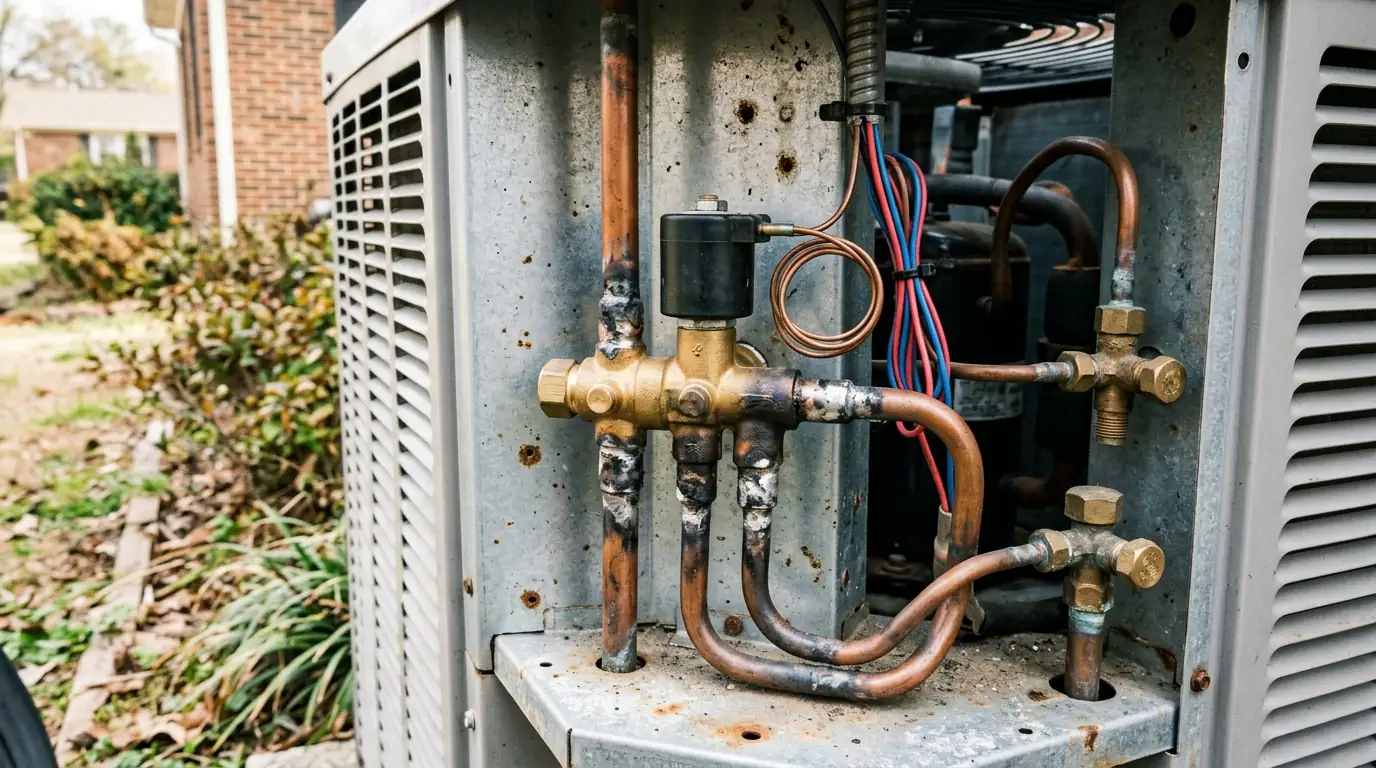
The reversing valve is the four-way valve that switches the refrigerant flow between heating and cooling. When it sticks, the system blows cool air on a heat call, or warm air in July. A failed solenoid coil on the valve can cause the same symptom, and that is the cheaper fix.
We check for 24 volts at the coil, the coil itself, and the temperatures on each line of the valve. A valve stuck mid-stroke has to be cut out and brazed in new, which means recovering the refrigerant, pressure testing with nitrogen and pulling a fresh vacuum.
Defrost board and sensor faults
The defrost control decides when the outdoor coil needs clearing, using a temperature sensor clamped to the coil and a timer on the board. A sensor that reads wrong, or a board with a failed relay, either never starts defrost or starts it constantly.
We force a defrost cycle and watch what happens: the outdoor fan should stop, the reversing valve should shift, the aux heat should come on, and the coil should clear. A bad sensor is a modest part. A board costs more, and we confirm the board is the problem before ordering one.
How long a heat pump repair takes
A defrost sensor, capacitor, contactor or fan motor usually takes an hour or two once the fault is found. A reversing valve or leak repair means recovery, brazing, a pressure test and an evacuation, which fills most of a day. If a part has to be ordered, the house runs on emergency heat meanwhile.
How a heat pump repair call runs
- 1
Tell us what you see
Aux heat on the thermostat, ice on the coil, or cool air on a heat call.
- 2
Test both modes
The technician reads pressures, coil and supply temperatures and amp draw, then forces a defrost cycle.
- 3
Price before parts
You get the failed part and the cost, plus the replacement option on an aging system.
- 4
Repair and run a full cycle
We watch the unit heat, defrost and recover before we leave.
What a Nashville cold snap does to a heat pump
During the January 2024 Arctic blast the Nashville airport fell to 1 degree below zero on January 17, and 7.6 inches of snow fell during the cold stretch. A heat pump in that weather defrosts again and again and leans on its strips, so weak defrost sensors, sticky reversing valves and tired fan motors fail in the same few days. Hermitage housing dates mostly from 1980 to 2009, so many homes there run a second or third round of equipment, and we see older and newer defrost controls side by side.
What a heat pump repair costs and why it varies
The failed part sets most of the bill.
For planning, Angi puts typical national pricing for this kind of job at $161 to $661, about $410 on average (Angi, May 2026). That is a market range, not our quote; the figure for your home comes after we see the equipment.
- The failed part. A defrost sensor or capacitor costs far less than a reversing valve, coil or compressor.
- Refrigerant work. Any repair that opens the sealed system adds recovery, a nitrogen pressure test, evacuation and a recharge.
- Refrigerant type. Older units on R-22 cost more to recharge because that refrigerant is no longer produced.
- Air handler access. An air handler in a tight attic or crawl space takes longer to work on than one in a closet.
- Time of the call. A call on a frozen night or a holiday can carry a higher rate than a weekday visit.
Brands we work on
We service and install equipment from the major manufacturers, including Carrier, Trane, Lennox, Rheem, Goodman, American Standard, Daikin, Mitsubishi Electric, Bryant, Ruud, York and Amana.
Heat pump repair questions from Nashville homeowners
Short bursts on cold mornings and during defrost are normal. Hours of it usually mean a fault or a staging setting.
Yes, for a few minutes during defrost. Smoke or a burning smell isn't, so turn the system off and call.
Briefly during defrost, that is normal. If it lasts, a stuck reversing valve, low charge or a failed outdoor fan is likely.
If the coil is solid ice or the outdoor unit is not running, yes. It heats on the strips alone and costs more to run, so treat it as a stopgap.
A sensor, capacitor or fan motor usually is. A failed compressor or reversing valve at that age usually points toward replacement.