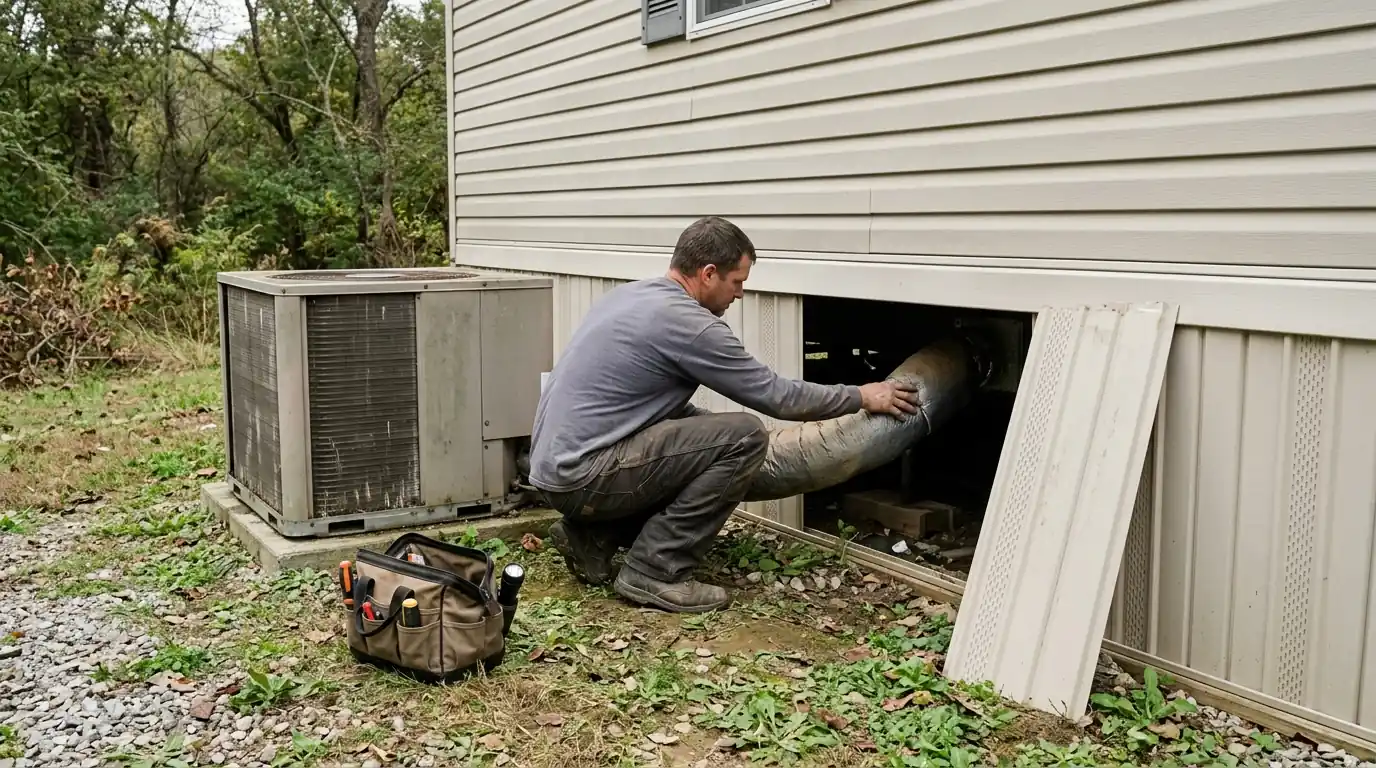
Mobile home HVAC around Nashville uses equipment built for manufactured housing: a package unit outside, or a downflow furnace or air handler in a closet, feeding a trunk duct inside the floor belly. Most no-heat and weak-airflow calls trace back to the blower, the crossover duct or a torn belly duct. Call (615) 412-2815 at any hour.
How mobile home heating and cooling is built
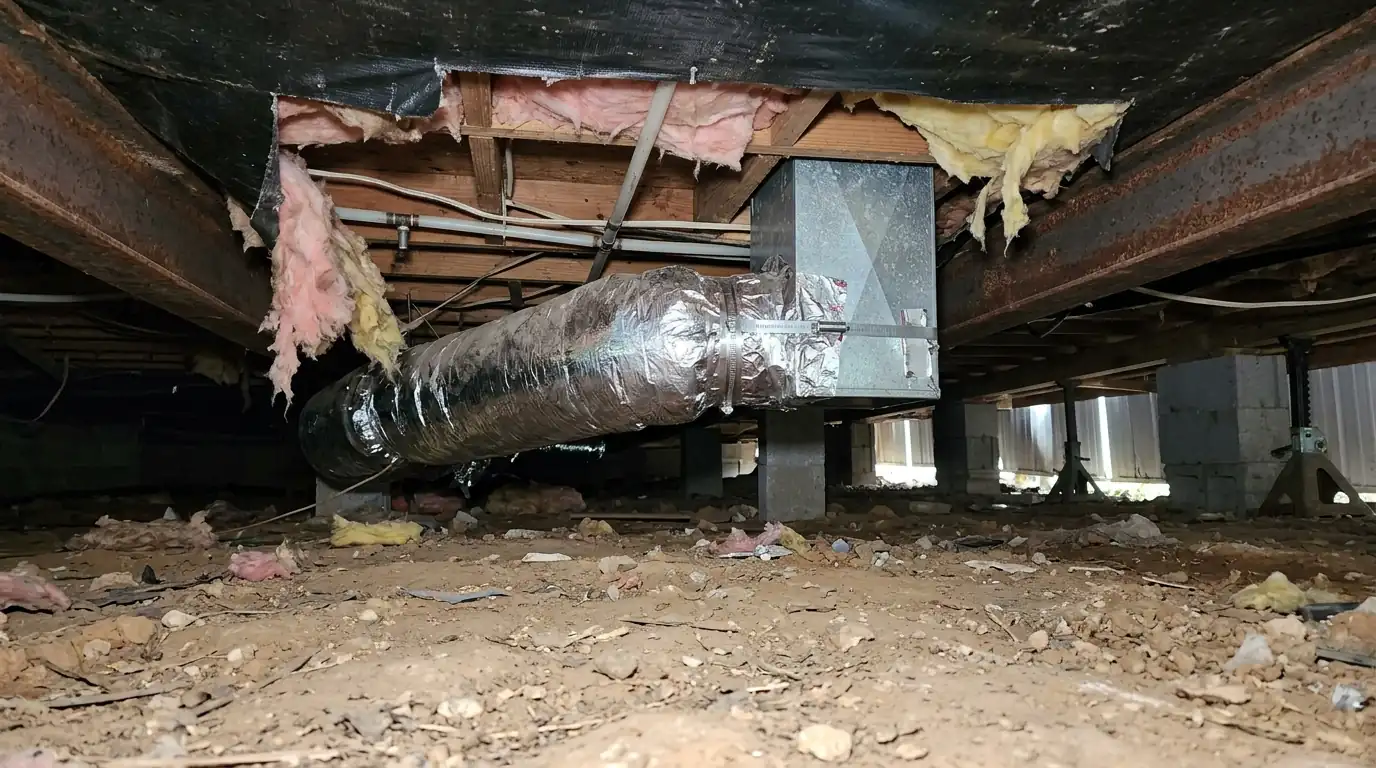
Manufactured homes are built differently, and the heating and cooling has to match. The duct is usually one metal trunk running down the middle of the floor, wrapped in insulation and held up by the bottom board. Supply registers sit in the floor, and the furnace or air handler is a downflow unit pushing air straight down into that trunk.
Replacement equipment has to be approved for manufactured homes, especially gas furnaces, which draw combustion air from outside. We check the crossover and the belly on every visit, because a torn duct can make a healthy system look broken. It's often the cheaper half of the repair.
Signs your mobile home system needs service
Air reaches the first rooms but not the ends of the home.
Missing belly insulation or a leaking duct cools the floor from below.
A hanging belly often means the duct inside has pulled loose.
A hum with no fan usually points to a capacitor or contactor.
A heat pump leaning on backup heat in mild weather has a defrost or charge problem.
Water in the belly can soak insulation and grow mold beside the ducts.
Package units
A package unit holds the compressor, coils, blower and often the heat in one cabinet beside the home, with supply and return ducts running under the skirting into the floor. When it runs but little air reaches the rooms, those flex connectors are often crushed, disconnected or chewed by animals.
When nothing runs, we check the disconnect, transformer, capacitor and contactor first. Package units sit low to the ground, so grass clippings, leaves and mud pack the coil faster than on a split system. Cleaning that coil and the drain is part of most repair visits.
Belly duct repair
The belly is the space under the floor sealed by a fabric or vinyl bottom board, and the main duct runs through it. Rodents chew through the board, wind tears it, and a plumbing leak can soak the insulation until the duct sags. The signs are weak air at the far registers, cold floors and higher bills.
We open the bottom board at the problem area, seal or replace the damaged duct, reconnect loose register boots, replace wet insulation and patch the board with tape made for it. On a double-wide we also check the crossover that links the two halves.
Manufactured-home heat pumps
Many manufactured homes heat with a heat pump tied to a downflow air handler or electric furnace in an interior closet. That air handler has to be one approved for manufactured housing, and its base must seal tightly to the floor duct so it does not pull air from the belly.
Common repairs are defrost board and sensor failures, low refrigerant from a line set rubbing on the frame, and backup heat strips that burn out on cold nights. When a heat pump is replaced, we size it to the home and match it to the existing air handler or replace both together.
How a mobile home HVAC visit runs
- 1
Tell us the setup
Single or double-wide, package unit or closet unit, and what the system is doing.
- 2
Test the equipment
We check power, controls, refrigerant and the blower before looking under the home.
- 3
Check the ducts
Airflow at the registers, the crossover and the belly show whether air is getting lost.
- 4
Repair and confirm
After the fix we run heat and cooling and measure airflow at the farthest registers.
Why mobile home calls are common north of Nashville
Robertson County has about 2,200 mobile homes, 7.4 percent of its housing, and Sumner County has about 4,300, or 5.2 percent. Our shop in Greenbrier sits on US-41 about 23 miles north of Nashville, so Springfield, White House and Gallatin are close by. Those homes don't share much with a site-built house: downflow air handlers, belly ducts and package units set beside the skirting. We treat each call as a manufactured-home job from the first question, so the right parts and approach come with it.
What changes the price of a mobile home HVAC repair
Manufactured-home repairs are priced by the failed part and by how much of the belly has to be opened.
- Equipment type. Package units, split heat pumps and downflow gas furnaces each use different parts.
- Approved replacement parts. Furnaces and air handlers for manufactured homes are specific models, and some cost more than site-built versions.
- Belly access. A small tear near the air handler is quick, while a long section of soaked duct takes more time and material.
- Crossover condition. On a double-wide, a crushed or disconnected crossover may need a new duct and new supports.
- Time of the call. Night, weekend and holiday calls can carry a higher service rate than a weekday visit.
Package unit or split system for a manufactured home
| Feature | Package unit | Split heat pump with air handler |
|---|---|---|
| Where it sits | One cabinet outside beside the home | Condenser outside, air handler in an interior closet |
| Indoor space used | None | A closet for the downflow air handler |
| Duct connection | Supply and return run under the skirting | Air handler drops straight into the floor trunk |
| Noise inside | Blower noise stays outside | Some blower sound from the closet |
| Service access | Everything reached from outside | Indoor and outdoor parts serviced separately |
Brands we work on
We service and install equipment from the major manufacturers, including Carrier, Trane, Lennox, Rheem, Goodman, American Standard, Daikin, Mitsubishi Electric, Bryant, Ruud, York and Amana.
Mobile home HVAC questions we hear
No. Gas furnaces in manufactured homes must be models approved for that use, usually sealed-combustion downflow units that draw outside air.
The usual causes are a torn belly duct, a disconnected register boot or a crushed crossover. We check those along with the equipment.
Both work. A package unit keeps everything outside and frees up the closet, while a split system with an indoor air handler is easier to match to an existing closet unit.
Yes, including the crossover duct that connects the two halves under the floor.
Yes. The phone is answered 24 hours a day, every day, including holidays.