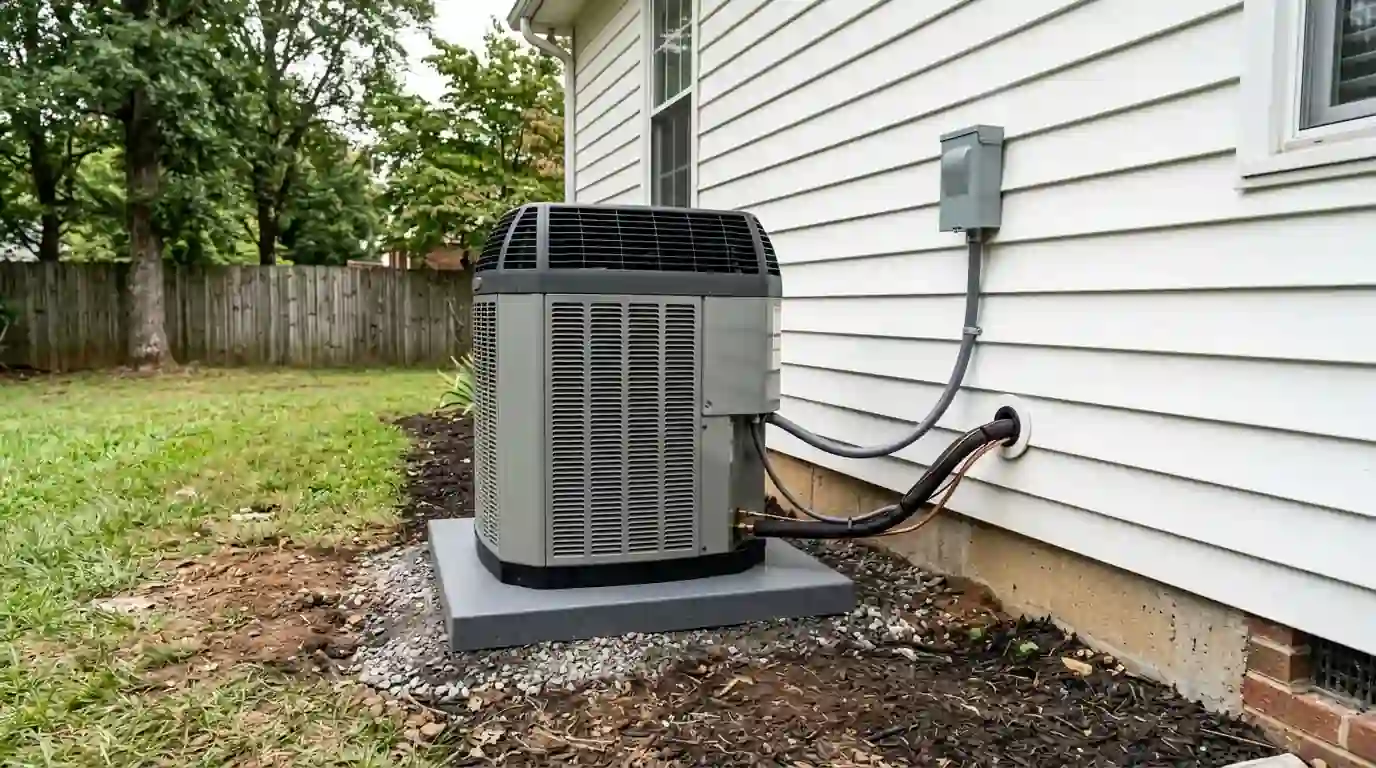
AC installation in Nashville starts with a Manual J load calculation, not square footage alone. That figure sets the condenser size, the coil and the airflow the ducts must carry. In an older home with no ducts, the duct plan comes first. Once you approve the equipment and price, the condenser, coil, line set and drain go in and get tested. Call (615) 412-2815 at any hour.
What goes into sizing and placing a new AC
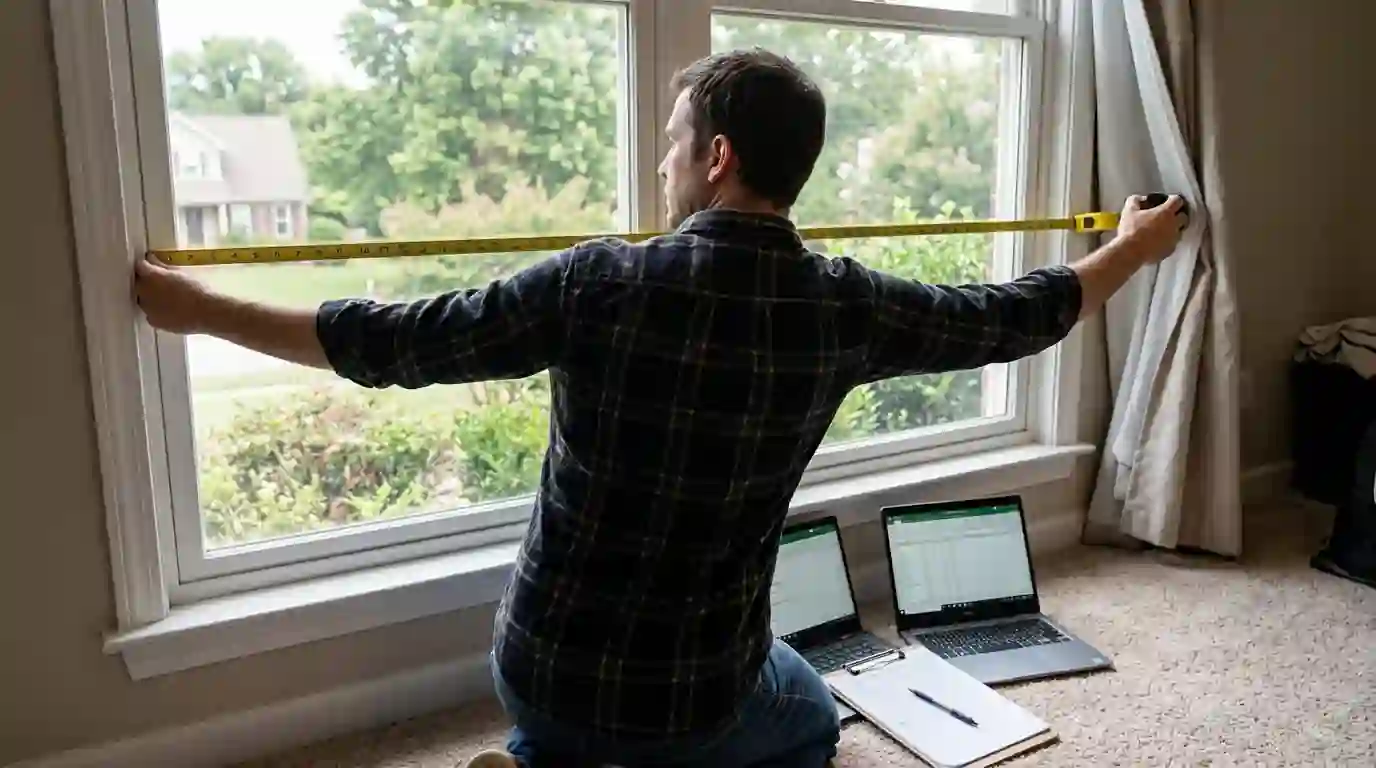
Putting central air into a house is three jobs at once: equipment, ductwork and electrical. We start with a load calculation that counts windows, insulation, wall direction and ceiling height in each room. That total decides the condenser size, and the room figures decide how much air each supply register needs.
From there we lay out where the condenser sits, where the indoor coil mounts and how the refrigerant lines and condensate drain run between them. You'll see the equipment, the duct plan and the price before anything is ordered.
First central air in an older home
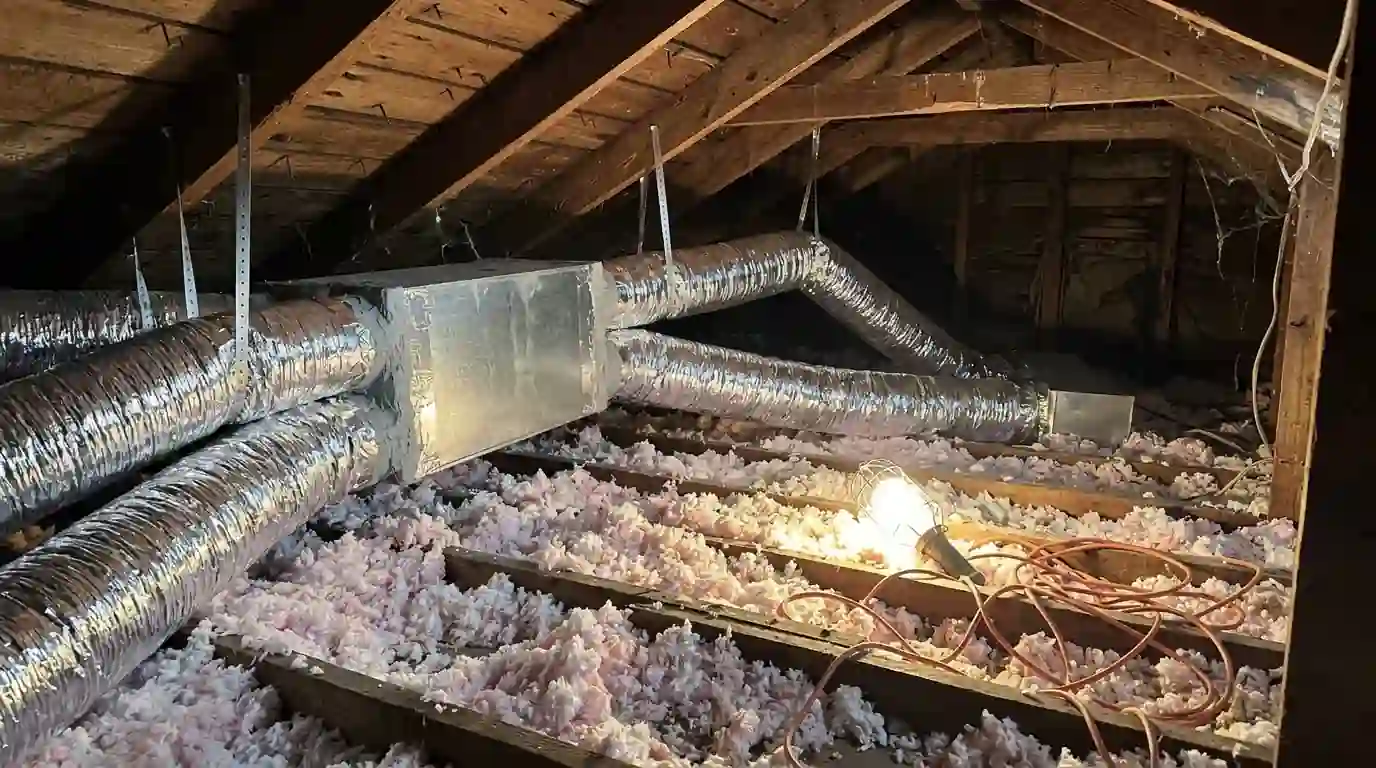
Plenty of older houses were built with a floor furnace, window units or no cooling at all. Adding central air there means building a duct system as well as setting equipment. We look at the attic, the crawl space and the closets to find a route for the trunk line and supply runs, and we check whether the electrical panel has room for a new 240-volt circuit.
Where ducts would mean opening finished walls, a ductless mini-split can be the cleaner answer, and we price both. If ducts make sense, the air handler or furnace, coil, condenser and return go in together.
Matching a new AC to an existing furnace
If the house already has a gas furnace and ducts, cooling goes on top of it. A cased evaporator coil sits on the furnace supply opening, the condenser goes outside, and a line set and drain connect the two. The match matters: the coil has to be rated for the condenser, and the furnace blower has to move enough air for the tonnage.
We check the blower speed taps, the static pressure in the ducts and the size of the return before choosing the condenser. An older furnace with a weak blower or a small return can hold back a new AC, and we'd rather say so up front than after it's installed.
Single-stage, two-stage or variable-speed: which fits your house?
| What you get | Single-stage | Two-stage | Variable-speed |
|---|---|---|---|
| How it runs | Full output every cycle | Low stage most of the time, high on the hottest days | Adjusts output in small steps |
| Humidity control | Basic | Better, from longer low-stage runs | Strongest, from long steady runs |
| Noise | Loudest at startup | Quieter on low stage | Quietest |
| Upfront cost | Lowest | Middle | Highest |
What drives the price of a new central air system
An installation is priced by the equipment and by how much of the house has to be prepared for it.
For planning, HomeGuide puts typical national pricing for this kind of job at $2,500 to $7,500 (HomeGuide, August 2025). That is a market range, not our quote; the figure for your home comes after we see the equipment.
- System size. The tonnage from the load calculation sets the condenser and coil price.
- Efficiency and staging. A two-stage or variable-speed condenser costs more than a single-stage unit of the same size.
- Ductwork. A house with no ducts needs a full supply and return system, which can rival the equipment cost.
- Electrical. A new 240-volt circuit, or a panel with no open space, adds to the job.
- Line set length. A long run between the coil and the condenser takes more copper, insulation and labor.
Sizing for a Nashville August, not a mild June
Nashville once ran 34 straight days at 90 degrees or hotter, from July 26 to August 28, 2007, and that August logged 15 days at 100 degrees or more. A new air conditioner has to hold the house through a stretch like that without running flat out all day. That is why we size from a load calculation. An undersized unit falls behind by late afternoon, while an oversized one cools the air fast but leaves the house damp and clammy.
What a central air installation includes
- Room-by-room load calculation
- Condenser set on a new level pad
- Matched indoor coil or air handler
- New insulated line set and condensate drain
- Nitrogen pressure test and deep vacuum
- Charge, airflow and temperature split checked at startup
How a new AC goes in, from load calculation to first cool-down
- 1
Measure the house
We take room dimensions, window sizes and insulation levels for the load calculation.
- 2
Lay out the system
You see where the condenser, coil, line set, drain and any new ducts will go, with the price.
- 3
Install and connect
The equipment is set, the copper is brazed under nitrogen, then pressure-tested and pulled into a deep vacuum.
- 4
Charge and verify
We weigh in the charge, check superheat or subcooling, and measure airflow and the temperature split.
Brands we work on
We service and install equipment from the major manufacturers, including Carrier, Trane, Lennox, Rheem, Goodman, American Standard, Daikin, Mitsubishi Electric, Bryant, Ruud, York and Amana.
Central air installation questions from Nashville homeowners
A Manual J load calculation is the right way. It counts the heat each room gains through windows, walls and ceilings, which is far more accurate than a square-footage rule.
Yes. We either design a duct system through the attic or crawl space, or recommend a ductless mini-split where ducts are impractical.
Usually, if its blower can move enough air for the new tonnage. We check the blower, the return size and the duct static pressure before choosing the condenser.
A single-stage unit runs at full output every time it starts. A two-stage unit runs on a lower setting most of the time, which gives longer, quieter cycles and pulls more moisture from the air.
Adding a condenser and coil to an existing furnace usually takes about a day. A new duct system adds more time, depending on the house.