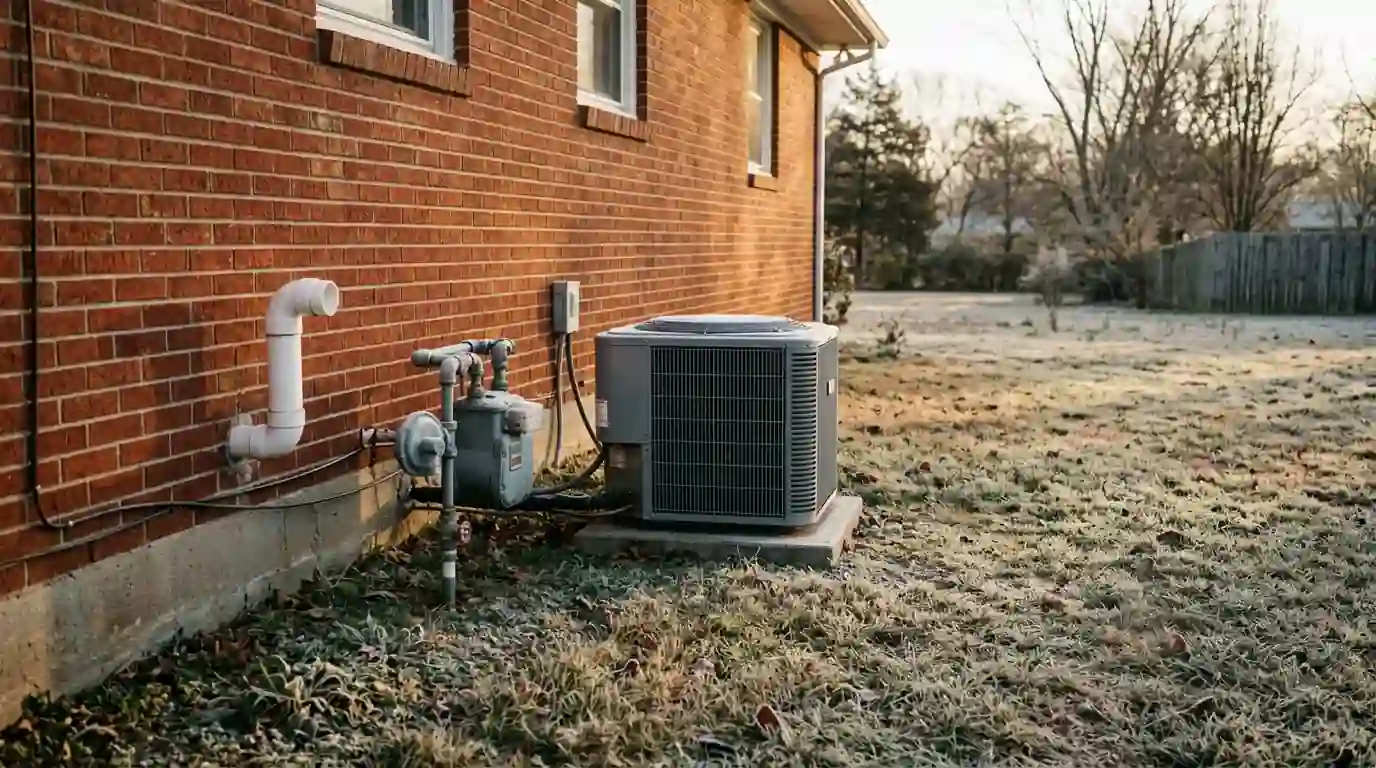
For most Nashville homes, a heat pump and a gas furnace both work well; the choice turns on whether gas service reaches the house and how much cold-night comfort matters to you. A heat pump heats and cools with one outdoor unit. A furnace delivers hotter air on a single-digit night. Dual fuel pairs the two. Call (615) 412-2815 at any hour.
How each system turns energy into heat
A heat pump does not burn anything. It uses refrigerant to pull heat out of the outdoor air and release it indoors, then reverses the same circuit in summer to cool the house. Because it moves heat rather than making it, a heat pump delivers more heat than the electricity it draws on a mild day.
That advantage shrinks as the outdoor air gets colder, since there is less heat to collect. Below a certain point, called the balance point, the heat pump cannot keep up alone and electric heat strips in the air handler fill the gap.
A gas furnace burns natural gas inside a heat exchanger and blows air across it. Its output barely changes with the weather, so the air at the registers feels hot whether it's 45 degrees outside or 5. A furnace still needs a separate air conditioner for summer.
What Tennessee homes already heat with
In the EIA 2020 residential energy survey, a heat pump was the main heating equipment in about 35 percent of Tennessee homes and a furnace in about 52 percent. Both are common here, and neither choice is unusual for a Nashville street.
The National Weather Service puts the normal January low in Nashville at about 30 degrees. A modern heat pump handles nights like that without much help, which is why so many houses in the region use one.
Gas availability decides a lot. Spire completed its purchase of the Piedmont Natural Gas Tennessee business on March 31, 2026, and now serves more than 200,000 Nashville-area customers as Spire Tennessee. If the house has no gas line, a furnace means running one first, and that becomes its own gas line project.
The cold nights that test a heat pump
Normal winters are not the problem. The test comes during an Arctic outbreak. The National Weather Service recorded -1 degree at the Nashville airport on January 17, 2024, a -7 degree wind chill on January 20 and 7.6 inches of snow during that week.
On nights like those, a heat pump leans hard on its backup strips, and the air at the vents feels lukewarm even when the house is holding temperature. It isn't broken; it's working at the bottom of its range. A gas furnace runs those nights the same way it runs any other.
If your thermostat shows aux heat often, our guide on why a heat pump says aux heat explains when that is normal.
Not sure which fits your house? Tell us what heats it now and whether gas reaches the street.
Call (615) 412-2815Running cost: the power bill against the gas bill
There's no single answer, because it depends on two rates you don't control: what your power company charges per kilowatt-hour and what Spire charges for gas. Efficiency ratings matter too. A heat pump is rated by HSPF2 for heating, and a furnace by AFUE, the share of the gas that becomes heat in the house.
Leaky ductwork raises the cost of either system. Air lost into a crawl space or attic is heat you paid for and never felt, so we look at the ducts before comparing equipment.
One point favors the heat pump in our climate: it also replaces the air conditioner. A furnace house still pays to run a separate condenser through the long Nashville summer.
What the published installed prices say
HomeGuide lists heat pump installation at $3,800 to $8,200 and furnace installation at $2,000 to $5,400. The furnace figure covers heat only, so a house that also needs new cooling adds an air conditioner on top. Fixr lists a dual fuel setup at $7,500 to $12,000, about $9,500 on average.
These are national ranges from those publishers, not our prices. A quote for your house depends on tonnage, the indoor coil, the ductwork and whether gas or electrical work comes with it.
TVA EnergyRight lists a rebate of up to $800 for a heat pump, filed by a member of its Quality Contractor group. Our rebate guide covers who files it.
When dual fuel makes sense in Middle Tennessee
Dual fuel pairs a heat pump with a gas furnace. The heat pump runs most of the season, and the furnace takes over below a set outdoor temperature. It suits a few situations well:
- A house that already has gas and needs a new air conditioner anyway.
- Owners who dislike the lukewarm feel of heat pump air on the coldest nights.
- Homes where the existing furnace is sound but the AC has failed.
- Houses with long duct runs where hotter supply air keeps far rooms comfortable.
It makes less sense in an all-electric house with no gas service, where the cost of bringing gas in can outweigh the gain. See dual fuel installation for how the switchover is set.
Outages, vent pipe rules and other details people miss
Neither system heats without electricity. A gas furnace needs power for its inducer fan, igniter, control board and blower. During the rolling blackouts TVA ordered on December 23 and 24, 2022, WSMV reported NES, Middle Tennessee Electric and Cumberland Electric customers saw 10 to 30 minute cuts, and both kinds of system stopped during each one.
Venting matters on a furnace install in Davidson County. Metro Codes amended the 2024 codes so plastic vent pipe on Category II and IV gas appliances must be listed to UL 1738 with contrasting primer, for projects starting after January 1, 2026. A high-efficiency furnace quote in Nashville should account for that pipe.
Questions readers ask
For most nights, yes. On the rare single-digit nights it relies on electric backup heat, which keeps the house warm but costs more to run.
It depends on your electric and gas rates, the efficiency of each unit and the condition of the ducts. There is no answer that fits every house.
Often, yes. If the furnace is in good shape, a heat pump can replace the air conditioner and the two run as a dual fuel system.
No. A gas furnace still needs electricity for its blower, igniter and controls, so both stop when the power is out.
Only the heat pump. A furnace handles heat alone and needs a separate air conditioner for cooling.
TVA EnergyRight lists a rebate of up to $800 for a heat pump when a Quality Contractor member installs it and files the claim.