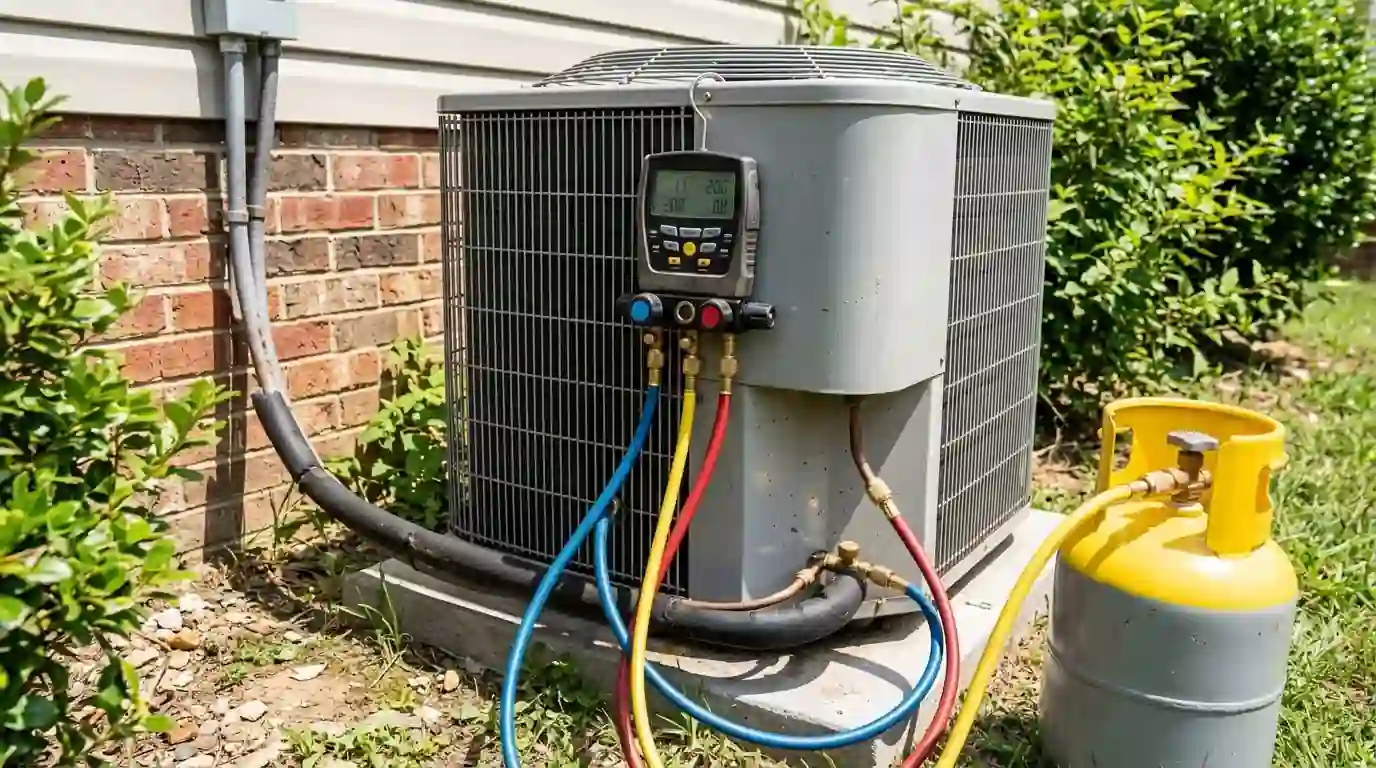
Nashville homeowners buying a new AC or heat pump will mostly see R-454B refrigerant. The EPA says new home systems generally cannot use refrigerants with a global warming potential of 700 or more from January 1, 2025, which ruled out R-410A. Existing R-410A systems can still be repaired and recharged. Call (615) 412-2815 at any hour.
What changed on January 1, 2025
According to the EPA, new home air conditioners and heat pumps generally cannot use a refrigerant with a global warming potential of 700 or more from January 1, 2025. R-410A, the standard for well over a decade, sits far above that line. Most manufacturers moved to R-454B, which sits well under it.
Global warming potential compares how much heat a gas traps in the atmosphere against carbon dioxide. A refrigerant only reaches the air when it leaks or is vented, so the rule aims at what escapes over the life of millions of systems.
The rule covers new equipment. It doesn't order anyone to remove a working system, and it doesn't stop a technician from repairing or recharging one. What it changes is the equipment you'll be offered when the current system reaches the end of its life, and the parts that have to come with it.
What R-454B is, in plain terms
R-454B is a blend that works at pressures close to R-410A, which let manufacturers keep similar compressor and coil designs. It is classed A2L, meaning mildly flammable. In normal operation that does not change anything for the homeowner.
It does change the equipment and the work. Many R-454B indoor units carry a refrigerant leak sensor that turns on the blower to dilute any leak. Technicians use tools and recovery cylinders rated for A2L refrigerants, and the system has to be charged and brazed with that classification in mind.
Your R-410A system is not obsolete
An R-410A air conditioner installed a few years ago can be repaired, recharged and maintained for the rest of its life. The refrigerant is still sold for service work. HomeGuide lists R-410A at $50 to $80 per pound installed.
What you can't do is mix refrigerants. A low R-410A system is never topped off with R-454B, and an R-454B condenser is not paired with an old R-410A coil. If a system is low, it has a leak. HomeGuide lists a leak detection test at $100 to $330 and the repair itself at $200 to $1,500, depending on where the leak is.
Finding and fixing the leak first is the point of refrigerant leak repair. Adding refrigerant to a leaking system only buys a few weeks.
Unsure what refrigerant your system uses? Read us the outdoor unit label and we will explain it.
Call (615) 412-2815The R-22 units still running around Nashville
Older systems may use R-22, which is no longer produced. HomeGuide puts R-22 at $90 to $150 per pound, so a large recharge on one of these units costs more than many repairs. If the label on your outdoor unit says R-22, it's already past the refrigerant change before this one.
A working R-22 system can keep running. The decision comes when it develops a leak or a major part fails, and at that point we price replacement next to the repair so you can compare.
Replacing an R-22 system skips a generation. The new equipment uses R-454B, the indoor coil changes, and the line set is usually replaced because old copper sized for R-22 may not suit the new system. The old refrigerant is recovered into a cylinder, not released.
Why a new condenser usually means a new indoor coil
A split system is designed as a matched pair. The indoor coil and its metering device are sized for one refrigerant and one outdoor unit. Pairing a new R-454B condenser with an old R-410A coil leaves the system running outside its design, with poor efficiency and stress on the compressor.
That is why most replacement quotes now include the coil, and often the line set. Where the copper lines can be reused, they are cleaned and pressure tested first. In a house where the coil sits in a tight attic or crawl space, that coil work is a real share of the labor, so expect it to show on the quote.
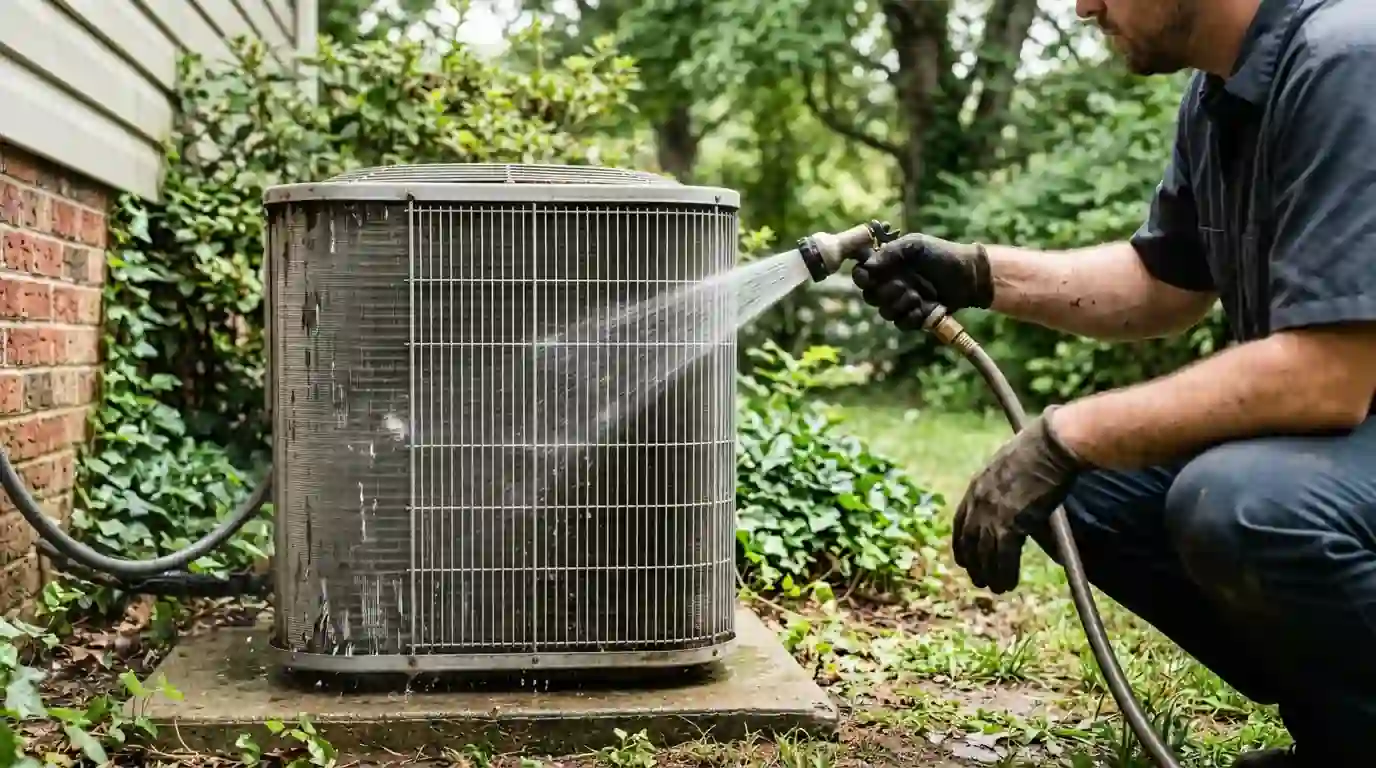
Repair or replace an older system now?
The National Weather Service records Nashville's all-time high at 109 degrees on June 29, 2012, during a stretch of near or above 100-degree days. A summer like that is when a tired system tends to fail, so it helps to decide ahead of time. A few questions settle it:
- Is the repair electrical, like a capacitor or contactor, or a coil or compressor?
- Does the system use R-22?
- Has it needed refrigerant more than once?
- Is the indoor coil or furnace also near the end of its life?
A small repair on a sound R-410A system is usually worth doing. Repeat leaks or a failed compressor on an older unit point toward AC replacement.
What to ask on a new-system quote
- Which refrigerant does the new equipment use?
- Is a matching indoor coil included?
- Is the line set new, or flushed and pressure tested?
- Does the indoor unit include a leak sensor, and how is it wired?
- Who handles the recovery and disposal of the old refrigerant?
Heat pumps and mini-splits follow the same rule
The EPA change covers new home heat pumps as well as air conditioners, so a heat pump replacement in a Nashville house goes through the same switch. That matters here because a heat pump runs in both seasons. A leak on one can't wait for spring, since the same refrigerant circuit carries the heat in January.
Ductless systems are moving through the change too, with their own refrigerant choices by manufacturer. Whatever the system, the nameplate tells you what it holds, and the same rules apply: no mixing, recover the old charge properly, and match indoor and outdoor parts.
If you are pricing a heat pump installation, the refrigerant line on the quote should read R-454B or another approved low-GWP refrigerant, along with a matching air handler or coil.
Questions readers ask
Yes. It is mildly flammable, so equipment built for it includes safeguards such as leak sensors, and it is handled with tools rated for it.
No. The rule covers new equipment. An existing R-410A system can be repaired and recharged for the rest of its life.
No. Refrigerants are never mixed, and an R-410A system is only charged with R-410A.
A new R-454B condenser needs a coil designed for that refrigerant. An old coil leaves the system running outside its design.
It is still sold for servicing existing systems. Prices may change over time as supply shifts.
Check the nameplate on the outdoor unit. It lists the refrigerant type and the factory charge.