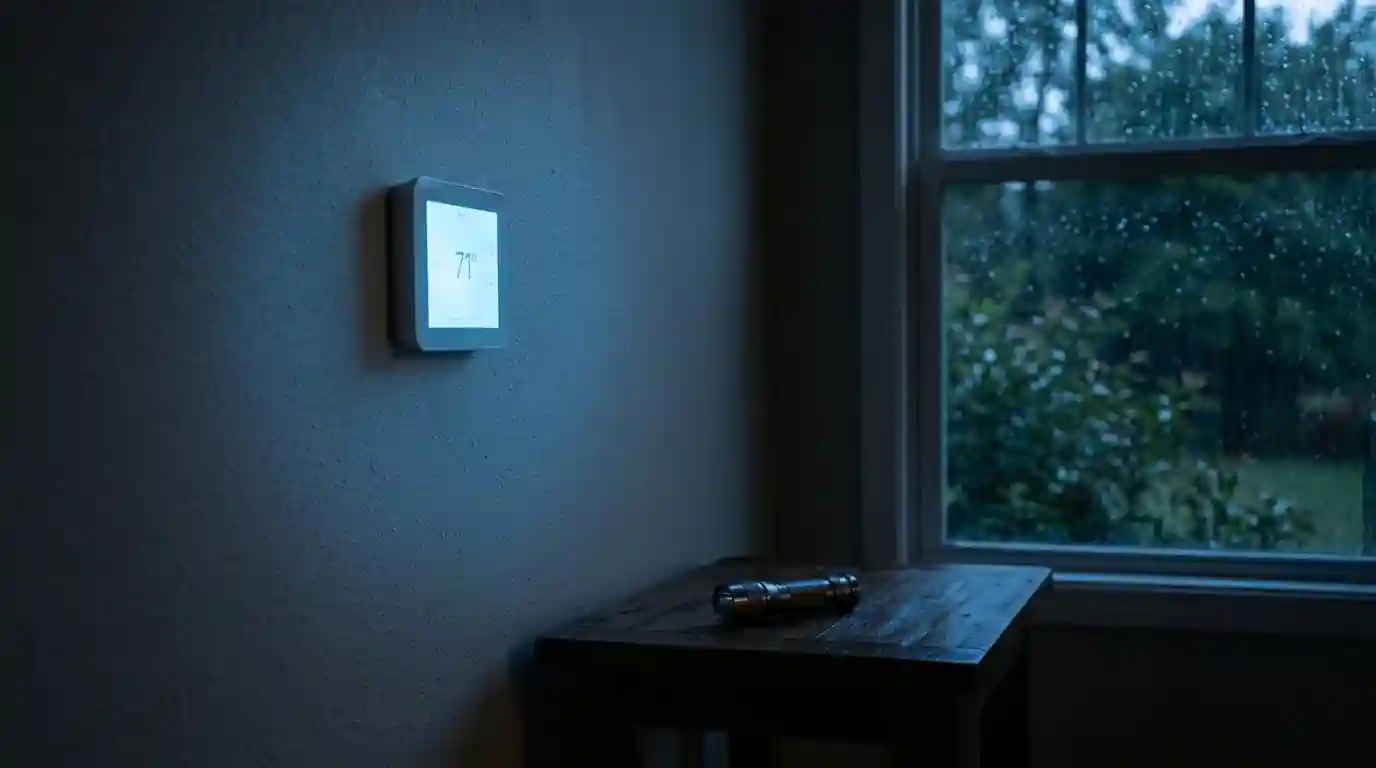
After a power outage in Nashville, set the thermostat to off, wait until the power has held steady for several minutes, check the breakers for the indoor and outdoor units, then turn the system back on. Most outdoor units also hold a built-in delay of a few minutes before the compressor starts. Call (615) 412-2815 at any hour.
Why the first minutes after the power returns matter
Power rarely comes back clean after a storm. Lines can flicker on and off several times as crews switch circuits, and each blink tries to restart a compressor that may still be holding high pressure. A compressor that starts against that pressure pulls heavy current, trips its breaker or overheats its windings.
Voltage dips and surges also stress the circuit board in the furnace or air handler, along with the run capacitor outside. Those are the parts we replace most often after a rough night of weather. So the restart order below begins with the thermostat set to off. You let the grid settle first, then bring the system back on your schedule instead of the utility's.
What the December 2022 rolling blackouts taught Middle Tennessee
WSMV reported that TVA ordered rolling blackouts across Tennessee on December 23 and 24, 2022. NES, Middle Tennessee Electric and Cumberland Electric customers saw cuts of 10 to 30 minutes, and more than 75,000 NES customers were out or in rotation at 8 a.m. on December 24.
Short, repeated cuts like those are hard on heating equipment. A heat pump that loses power in a cold snap comes back to a chilly house and a thermostat calling hard for heat. That often switches on the electric backup strips at the same moment thousands of neighbors do the same. Our guide to aux heat explains why the bill jumps when that happens.
If your utility announces rotating outages, set the thermostat a few degrees lower and leave it there. Chasing the temperature after every cut only adds load when the grid can least afford it.
The restart order, step by step
This sequence works for central air, heat pumps and gas furnaces alike.
- Set the thermostat to off as soon as the power fails, or as soon as you notice that it did.
- Wait for steady power. Give it several minutes with the lights holding before you touch the system.
- Check the breakers. Look at the panel breakers for the furnace or air handler and for the outdoor unit, plus the disconnect box beside the condenser.
- Reset a tripped breaker once. If it trips again, leave it off and call.
- Turn the system back on in heat or cool, then give the outdoor unit about five minutes before you judge it.
- Confirm air at the vents. Warm or cool air within 10 to 15 minutes means the restart worked.
Many thermostats lose their clock or schedule after a long outage. A blank screen often just means dead batteries in a battery-powered model, so swap those before you assume the board failed.
Power is back but the system will not start? Call and tell us what the outdoor unit is doing.
Call (615) 412-2815Heat pumps after a long outage in freezing weather
The National Weather Service recorded -1 degrees at the Nashville airport on January 17, 2024, during the Arctic blast that also dropped 7.6 inches of snow. An outage in weather like that creates a specific problem for heat pumps.
Many outdoor units carry a crankcase heater that keeps the compressor oil warm and separated from the refrigerant. After hours without power in deep cold, that oil can be thick and diluted. Some manufacturers advise restoring power with the thermostat still off for a period before the compressor runs. Your owner's manual gives the figure for your model.
If the house is cold while you wait, a system with electric strips can run on emergency heat for a while. Check that the outdoor unit isn't buried in ice or snow before switching back to normal heat.
Generators, carbon monoxide and the furnace blower
A gas furnace still needs electricity. The inducer motor, the igniter, the control board and the blower all run on household power, so a gas furnace gives no heat during an outage.
Portable generators keep a lot of Nashville homes warm through a long outage, and they are also the most common source of carbon monoxide trouble in one. Run a generator outdoors only, well away from doors, windows and vents, and never in a garage, basement or crawl space. Feeding a generator into house wiring takes a transfer switch installed by an electrician, because backfeed can injure line crews.
If a carbon monoxide alarm sounds, get everyone out of the house and call 911 from outside. Do not go back in until responders say it is safe.
When storm water reached the equipment
Heavy rain can do more damage than the outage itself. The National Weather Service recorded 13.57 inches of rain at the Nashville airport in the May 1 and 2, 2010 flood, and much of that water ended up under houses and in low utility rooms.
If water reached the outdoor unit, the furnace, the air handler or the ducts, do not turn the system on. Gas valves and control parts that have been under water are replaced, not dried out and reused. Ductwork that held floodwater usually needs replacing, which our crawl space duct guide covers in more detail.
Signs the restart did not work
Call for a visit if you see any of these after the power returns:
- The outdoor unit hums but the fan never spins.
- A breaker trips a second time after one reset.
- You smell hot plastic or burning wire near the furnace or air handler.
- The furnace or air handler shows a flashing error light that keeps repeating.
- The blower runs, but the air from the vents never warms or cools.
Outage calls often land at night or on a holiday weekend. HomeGuide lists after-hours HVAC rates of $160 to $250 an hour for nights, weekends and holidays, with service call fees of $75 to $200. We'll tell you on the phone whether it can safely wait for a weekday.
Outage and restart questions
Yes. Set the thermostat to off so the system does not try to restart every time the power flickers back on.
Wait until the power has held steady for several minutes. Most outdoor units also have a built-in delay of about five minutes before the compressor starts.
The usual causes are a tripped breaker, a thermostat that lost its settings or dead batteries, or a capacitor or control board damaged by the surge. If a breaker trips twice, leave it off and call.
Only through a transfer switch installed by an electrician. Never run the generator indoors, in a garage or near windows.
Get everyone out of the house right away and call 911 from outside. Stay out until responders say it is safe.
Yes. The phone is answered 24 hours a day, every day, holidays included.